Showing posts with label bunker. Show all posts

Wednesday, May 20, 2026

New Bunker Complex Built Near Kumgang

A new unidentified bunker complex has been constructed in the village of Sangsedong-ni (상세동리) 38.696186° 127.846879°, about 14 km northwest of Kumgang and within 45 km of the DMZ. 

The site covers approximately 329 hectares (814 acres) and consists of eleven covered bunkers, a headquarters/administrative area, and ten apartment blocks. However, the bunkers don't conform to typical weapons storage structures seen in the rest of North Korea, and so the complex may have other uses such as equipment storage or even a military-industrial purpose like manufacturing/handling explosive materials.

Overview of the new Sangsedong-ni bunker complex. Google Earth, Nov. 8, 2025.

Based on AccessDPRK mapping, North Korea has over 1,500 known individual military storage locations, from simple weapons storage bunkers found at front-line units to the suspected underground nuclear warhead facility at Yongdoktong, with hundreds of other likely storage sites hidden away in lesser-known tunnels. Around 200 storage sites are large facilities covering multiple hectares. 

While sites are periodically renovated or gain expanded capacity with new bunkers being constructed, the vast majority of North Korea's storage areas are decades old. The Sangsedong-ni complex is the newest large-scale potential storage facility to be constructed. 

Residential and administrative area of the base prior to renovation. Google Earth, Sept. 29, 2022.

Prior to the construction of the bunkers, what is now the administrative area was a small, compact Korean People's Army facility with ten barracks across from a central parade ground, and little change can be noted at the base or surrounding valley on high resolution imagery from Google Earth which goes back to May 2, 2005.

The first signs of change began in May 2024 but work on the hardened structures didn't really take shape until April through July 2025. 

As seen in the image below, the probable barracks structures were removed during the site's reconstruction, but the original three administrative buildings remain in their original condition. Five unidentified new structures were also constructed to the south of the administrative site.

Residential and administrative area of the base after renovation. Google Earth, Nov. 9, 2025.

Before the site was converted to its present use, there was a collection of twenty duplex houses north of the administrative section totaling forty housing units, just inside of the base's guarded entrance. By 2025, the entrance was moved 260 meters further north and the original homes were demolished. 

To replace the duplexes, ten three-story apartment buildings were built, providing 156 individual units. The apartments are in the same 'peculiar' style as the new apartment buildings being constructed throughout the country.

This increase in living space (up from 40 units) may also be to replace the lost barracks space that existed in the administrative section of the base.

Additionally, in an adjacent valley (38.695107° 127.841137°) just outside of the base, the foundations for seven more apartment buildings were prepared. However, as of April 2026 no further construction has taken place. Whether or not these were intended to be part of the base or to provide more housing for associated personnel isn't known, but small construction projects are routinely abandoned in North Korea and I'm only mentioning this one due to its proximity to this complex. 


To the south of the residential and administrative area are eleven bunkers and support buildings. 

Map highlighting the locations of each bunker. Google Earth, Nov. 9, 2025.

The bunkers are standard rectangular concrete box forms (~30 x 7 meters) that are then covered by earth, and each have an entry structure wide enough to allow a vehicle through.

The entry structures appear to have an accessible upper floor with either windows or openings in the outer wall. The purpose of this floor is unknown but may also be part of a "camouflage, concealment, decoy" (CCD) deception scheme to misled foreign observers/analysts. 

Detail image showing a close-up of individual bunkers. Google Earth, Nov. 9, 2025.

There are no protective berms at the facility, which are often seen in locations where explosive materials or weapons are stored (or manufactured), however each of the bunkers are positioned a minimum of 70 meters apart from each other and none of the bunker openings face the opening of another bunker, which adds to the bunker's protection.

The purpose of this complex is speculative but although storage may be the easiest conclusion, military-industrial purposes can't be ruled out.

At the same time, using the structures to protect TELs or mobile artillery, particularly in light of the Ukraine and Iran wars, would make very little sense as the bunkers are in static positions, highly visible, and aren't buried deep enough to offer protection from even common missile systems like the American Tomahawk cruise missiles or the South Korean Hyunmoo-3

Construction around the complex is still not complete as of May 2026 but there doesn't appear to be spaces under preparation for any additional bunkers. 


I would like to thank my current Patreon supporters who help make AccessDPRK possible: Donald Pearce, David M., Dylan D., HG, Joe Bishop-Henchman, Joel Parish, John Pike, Jonathan J., Kbechs87, Russ Johnson, Squadfan, Timberwolf, and Yong H. 

--Jacob Bogle, May 20, 2026

Monday, November 11, 2019

Mystery at the National Defense University

Pyongyang's National Defense University (recently renamed the Kim Jong Un National Defense University) lies to the north of downtown Pyongyang in an area full of military and secret security schools and training centers. The NDU is located next to the Second Academy of Natural Science (which goes by several other names) as well as near the Kim Jong Il People's Security University.


The NDU has undergone several changes since Kim Jong Un's rise to power but one that hasn't received much attention is a small addition constructed in 2014. It was noted in the AccessDPRK Phase II map release in 2017, but I didn't know much about it and it lay forgotten until now.


The area in question is a small, tunnel-like structure or bunker that was set into the side of a hill. It also has an opening in the roof of the structure. 

Initial excavation work began in 2013 but the structure wasn't constructed until 2014. In Sept. 2014, apparent damage to the roof of the nearby white building was also observed. There has been a building on that site since at least 2000, however, it was reconstructed in late 2013.
To my eyes, the damage looks like there was a small explosion of some kind that blew through the roof. 


Since then, another building was constructed nearby in 2016 and an existing building was demolished in 2017. Additionally, during 2014, roughly 245 meters to the north-northeast of the bunker, a small structure was built on a hill. It resembles an observation hut, but there is some question if there is a clear line of sight from the hut to the bunker. It may just be an observation hut for activities happening in another part of the university compound that was simply constructed at the same time.


In Sept. 2019 I decided to try and solve this little mystery. I reached out to Joseph Bermudez, senior image analyst at the Center for Strategic and International Studies, and to Joshua Pollack and David Schmerler, both senior research associates at the James Martin Center for Nonproliferation Studies, to see if they could lend any insight.

Not being a missile expert, my initial thought was that the site may have been a horizontal test structure for testing either small scale-models of rocket engines or to test certain pieces of technology. I came to this conclusion because A) the NDU has been involved with the development of North Korea's missile technology, B) I thought that the opening would allow engine exhaust to flow out without damaging the rest of the concrete structure, and C) because learning about complex systems require learning about the fundamentals first. As with rocket hobby groups elsewhere, the bunker could be used to familiarize students with simple examples of solid fuel rocket engines. 

Unfortunately, none of the three experts seemed to think my idea was right, and all gave their own various reasons for that. So, still left with a mystery, I asked them what their impressions were. 

Joseph Bermudez said that his initial thoughts were that it's either a small firing range for handguns or a small explosive ordinance disposal (EOD) site for "training/familiarization". He also said that the damage to the roof of the other building couldn't be positively identified without doing more in-depth image analysis, but that it didn't necessarily have to have been caused by an explosion.

I doubt that it is a firing range because many examples of those exist, both large and small, and none take on this form, but some kind of EOD site does makes sense.

Joshua Pollack also raised the possibility of the bunker structure having to do with explosives, either training or testing. David Schmerler called its utility for substantial testing/training into question because of a general lack of infrastructure to move vehicles and equipment around (access to the site is through dirt paths). However, small vehicles can make it to the site and small-scale experiments/training could be carried out.

In conclusion, there is no conclusion. While the general consensus is that it may have something to do with explosives, there still exists the questions of what kind of explosives (weapons, demolition, solid rocket fuel, etc.) and for what purpose (testing, disposal, training). As it stands, the site doesn't currently seem to be easily identifiable, it appears to be the only structure of its kind in the country, and generally remains a mystery. Perhaps as time goes on and newer images of the site become available its function will become clear. Until then, I have another North Korea Mystery to add to the list.

If you have a credible explanation (or better yet, proof) of what the site is or additional information that may be useful, please feel free to comment or otherwise get in touch.


I would like to thank my current Patreon supporters: Kbechs87, GreatPoppo, and Planefag.

--Jacob Bogle, 11/10/19
Patreon.com/accessdprk
JacobBogle.com
Facebook.com/accessdprk
Twitter.com/JacobBogle

Wednesday, January 23, 2019

New Ichon Military Base

The town of Ichon, Kangwon Province is located a mere 20 miles from the DMZ, and 5 miles east of the town, new facilities have been popping up in the hills of the Kŏnsŏl-li valley.

Click on any image for a larger view.


Based on open-source satellite imagery, construction began in 2015 and lasted until late 2017. It includes bunkers, storage sites, and housing facilities.

The below image shows the locations of all of the bunkers, storage sites, and some other features.


This military base is of brigade size and likely plays a role in the production and storage of various munitions.

This 2013 image shows the two small valleys where most of the sites are located prior to any construction.

This 2017 image shows the area after construction, with multiple new buildings and 23 new housing units.

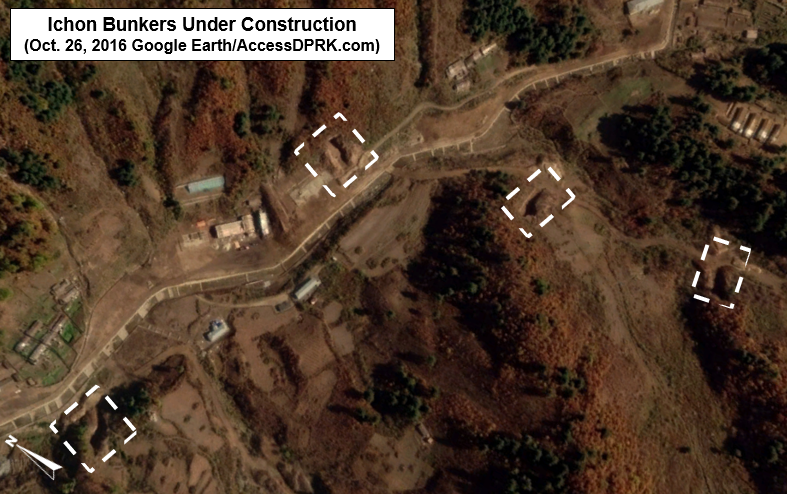
This 2016 image shows various bunkers under construction. The base has 8 (possibly 9) bunkers, two hardened structures, and at least one underground site.

The existence of protective berms between many of the buildings, and the presence of storage facilities suggest that this base is used in the manufacture and/or development of ammunition. There is no apparent testing range, so it is unlikely that this is some kind of training base, which would also require ammunition storage.


This new addition may help support other military units in the area. Specific details about this site are sparse, however, it ties into the previous article I wrote on the continued growth of North Korea's conventional forces despite sanctions and talks of peace.


--Jacob Bogle, 1/23/2019
www.JacobBogle.com
Facebook.com/JacobBogle
Twitter.com/JacobBogle