Sunday, January 21, 2024

DPRK's Fuel Transport and Storage Network: an Introduction

North Korea doesn't have its own domestic supply of oil and relies on legal and illicit transfers of petroleum products for its economy to function. While AccessDPRK has documented the proliferation of gas stations around the country, those exist parallel to North Korea's traditional oil storage and delivery network, which it has maintained for decades. 

Pyongyang-Kaesong Highway gas station at 38.973769° 125.719252°. Image: Wikimapia/Mar12.

In much of the world, going to your local gas station is how most individuals get fuel. There are stations for cars, trucks, and there are dedicated fueling depots used for institutions that have large fleets of vehicles like municipalities. But until recently, getting fuel in North Korea wasn't so simple.

Sixty-nine percent of the 190 gas stations identified by AccessDPRK have been built under Kim Jong Un, and even those aren't enough to cover every town and village - let alone the needs of factories, universities, collective farms, and other organizations that operate multiple vehicles and pieces of equipment.

So, most organizations still rely on an older system of refueling. 

While the specifics of how this system works remains little understood, I feel that I have been able to locate enough of the infrastructure (which is often buried underground or in hardened structures) to write an introduction to this system that serves as the backbone of fuel delivery and storage in North Korea.

To place this system in context, I'll quickly review North Korea's petroleum infrastructure.

North Korea is only allowed to legally import 4 million barrels of unrefined petroleum products and 500,000 barrels of refined petroleum products (like gasoline and kerosene) each year under United Nations' restrictions.  

North Korea imports petroleum products via ship and rail transfers as well as from a single pipeline coming from China into Sinuiju, the PRC-DPRK Friendship Oil Pipeline. North Korea has two refineries but largely relies on the Ponghwa Chemical Factory which is nearest Sinuiju. 

This map shows where North Korea's refineries and main oil terminals are located.

From its refineries and system of storage depots at key coastal terminals, legal (and an ever increasing amount of illegal) petroleum products are then transported to intermediate depots around the country. 

As mentioned, part of the fuel is sent from those terminals via rail and then truck to the country's gas stations.

But as you can see, they are not evenly distributed around the country and also only provide a limited storage capacity.

The bulk of the nation's fuel gets stored elsewhere, at facilities large and small, and can then be transported to factories, farms, and other organizations that need to fuel their own vehicles and equipment.

Map of just some of North Korea's internal petroleum storage facilities.

I currently have nearly ninety of these internal storage sites located. As mentioned earlier, most of the facilities are either underground or located within covered/hardened bunkers, making their identification difficult. Most, however, are near railways and so I believe I will be able to locate a considerably greater number of them in the future.

But with the sites that have been located, I can show each of the steps from the main terminals down to the local level.

Nampo's key petroleum depot is located at 38.720407° 125.366678°. It is one of North Korea's most important petroleum storage facilities, and also receives shipments from vessels engaged in illegal transshipment operations. 

Currently it has fifteen storage tanks for different types of refined petroleum products. The depot has grown in recent years with two new tanks added since 2019, and there is prepared space for a further twelve tanks. Two additional facilities also lie within a few hundred meters from this site.

Taedong Storage Site 39.094303° 125.615255°

From the main receiving depots like Nampo, petroleum can be shipped by rail to intermediate storage facilities. This one is near the town of Taedong, west of Pyongyang.

The Taedong Petroleum Storage Facility.

At Taedong, four large storage tanks - each approx. 20 to 25 meters in diameter - are partially set underground and are covered with large mounds of dirt.

Oil is brought to them via a pipeline from a rail terminal 750 meters away. Once inside the complex, the main line splits into smaller feeder pipelines that can fill or drain each tank independently. Taedong is one of the largest of these internal facilities and is just 1.3 km away from five anti-aircraft artillery batteries, and it is covered by several surface-to-air missile sites as well owing to its proximity to Pyongyang. 

Within Pyongyang is a large, central storage facility at 39.082890° 125.707182°.

The complex covers 12.4 hectares and contains large storage tanks like at Nampo, and smaller tanks that can be seen in towns outside of the capital and even at gas stations.

From these larger storage facilities, the fuel is then distributed via tanker trucks to their destined town or village.

One such site is in Kuum-ni at 38.898954° 127.908719°.

In this 2004 image, the individual storage tanks are visible.

Kuum-ni lies on the rail line in between Changjon and Tongchon in Kangwon Province. Its storage site comprises fifteen tanks, each 10-11 meters long.

By 2013, the tanks have been covered up.

Over time, most of the open tank facilities like Kuum-ni have had their storage tanks placed in bunkers or covered over with soil. In this 2013 image, new vent pipes are visible as small white dots.

Civilian organizations (factories, farms, etc.) have their own on-site fuel storage, and can draw from these "community" facilities. Sometimes it's a considerable amount (thousands of liters) or just a few small storage barrels, depending on their individual needs. 

The military has its own fuel supply system, and their needs are prioritized over civilian organizations. 

This system, while theoretically efficient in a country lacking internal pipelines, is also prone to abuse as local party bosses have considerable influence over the local fuel supply. And, there many opportunities for fuel to be stolen or diverted elsewhere; from black market activity to diversion for personal use, and the occasional need to 'donate' fuel back to the government, an unknown but likely large percentage of the country's fuel supplies end up being taken out of normal availability.

Regardless of the inefficiencies in North Korea's supply structure and economic policies, the country has managed to continue to import far more fuel than UN limits allow, even through the border closures brought on by the pandemic. 

Given a lack of comprehensive data about North Korea's imports, monitoring other parts of the country's petroleum infrastructure, like the growth, renovation, or demolition of storage facilities, can provide additional insight into how much the country is capable of bringing in and storing long-term. 

Petroleum storage, while not always the most interesting subject, plays a role in North Korea's ability to withstand sanctions, border closures, and any future blockade during a war. Improving our understanding of this topic can also help us to gauge the strength of its economy and its ability to manufacture a range of goods. 


I would like to thank my current Patreon supporters who help make all of this possible: Alex Kleinman, Amanda Oh, Donald Pierce, Dylan D, Joe Bishop-Henchman, Jonathan J, Joel Parish, John Pike, Kbechs87, Russ Johnson, and Squadfan.

--Jacob Bogle, 1/21/2024

Friday, December 22, 2023

Farming on the Frontier

North Korea shares 1,369.3 km of border with China and Russia. Predominately demarcated by the Yalu and Tumen rivers, the border regions are mountainous, with the available farmland often squeezed into thin strips or even onto islands that completely flood every few years.

With a few exceptions, such as the plains around Taehongdan and Onsong, farming in this region doesn't contribute significant amounts to the national food supply. However, they are important locally as are the forests which harbor herbs, mushrooms, and other plants used for food and in traditional medicines, and access to these lands provides additional income to local farmers and foragers. 

But, the government's response to the COVID-19 pandemic has placed that access at risk.

Through the construction of two layers of border fence, the land in between has become subjected to additional checkpoints, and many of the forests have become completely off limits. 

Farmer and ox cart at the Migok Collective Farm (2008). Image source: Stephan (Flickr), CC BY-SA 2.0.

North Korea has attempted to secure the full border in the past but never succeeded in doing so until COVID-19. Using the pandemic as justification, even the most impassable parts of the border are now fenced off with over 1,000 km of new fencing and thousands of additional guard posts having been constructed.

Even in this mountainous region of North Pyongan Province, where the Yalu swells to over two kilometers wide in some spots, electrified fencing has been erected to prevent anyone from fleeing the country.

As seen in the next image, the double row of fencing cuts through not only mountainous regions but also through farmland, disrupting the typical flow of human activity in those areas.

Detail of the border fence. Location: 42.967323° 129.999220°

Sometimes those fences are separated by only a few meters but in other areas it can be as much as a kilometer. In total, over 260 sq. km. of farmland and forest lies between the two fences, cut off from easy access. 

In this area, 17 sq. km. of land (highlighted in green) have been cut off by the two rows of fencing. 

In other areas, the fences run much closer together. At the narrowest point in this image, they are only 60 meters apart.

The land that has always belonged to official farms continues to be cultivated, even in places where the fences are close together, but the secondary fence prevents farmers from easily accessing that land, placing an additional hardship on them. Furthermore, parts of the border are alleged to hold landmines and the placement of those mines could further complicate the farmers' relationship with the lands they're required to work.

Checkpoint example #1 at 42.540183° 130.443553°.

Checkpoint example #2 at 42.544376° 130.477298°.

Positioned along roads that pass through the secondary fence are small checkpoints to verify the identification of everyone that tries to enter the border region. Not all of the existing road network remains open, however, with the fence just cutting across the road, and closing it. By limiting the number of access points, North Korea can funnel activity through a more manageable number of fence crossings, increasing overall security.


However, the fence doesn't only impact official farms. Illegal plots of farmland (sotoji) have been an integral part of North Korea's black market economy for decades, and they play an important role in supporting local economies and supplementing local food supplies, with corn, cabbage, potatoes, and soybeans being common crops.

Although the land in between the fences (and the illegal farms it holds) no longer appear to be openly accessible, entry to the sotoji could still be possible by bribing checkpoint officers as bribery and corruption is already rife in North Korea. If bribes are required, however, that is yet one more slice of income taken away from farmers (who, in the case of sotoji, could be anyone from professional farmers, teachers, and miners, to retired persons). 

If, however, access to the land has been permanently blocked and many or most of the fields are no longer cultivated, then that will have a direct impact on the many small villages and hamlets that can be found along the border region.

Examples of sotoji found within the fenced area. Location: 40.622524° 125.280157° 

In this area (imaged above) northeast of Pyoktong, North Pyongan Province, sotoji comprise roughly half of the land with forests occupying the other half.

Nationwide, an estimated 550,000 hectares are suspected of being sotoji, and DailyNK estimated that some 20% of all grain grown in the country in 2007 came from these irregular farms. Of course, land use patterns evolve over time, but as Andrei Lankov wrote in 2011, "the percentage of land under the cultivation of sotoji owners roughly equals that under cultivation by state-run farms" in some counties that border China. And, indeed, numerous of these illegal plots can be found within the new border fence area.

Crop yields nationwide have struggled in the last few years, but there haven't been any studies yet that focus on the border area that might tell us how the sotoji have fared with the construction of the border fence.

Whether it's a border blockade cutting off cross-border trade and impacting the lives of thousands living in the villages and hamlets of the area, or whether it's the construction of scores of additional checkpoints between towns and counties, and even surrounding Pyongyang, the government has used the pandemic as an excuse to crack down on human movement in ways greater than ever before.

Unfortunately, the difficulties imposed by the dual-layer border fence system on local populations aren't likely to lessen as authorities continue to extend the state's power over the economy and the freedom of movement. 


I would like to thank my current Patreon supporters who help make all of this possible: Alex Kleinman, Amanda Oh, Donald Pierce, Dylan D, Joe Bishop-Henchman, Jonathan J, Joel Parish, John Pike, Kbechs87, Russ Johnson, and Squadfan.

--Jacob Bogle, 12/22/2023

Tuesday, November 21, 2023

Post-COVID Update - Onpho and Tanchon

With internal pandemic restrictions slowly now lifting and international trade beginning to resume (albeit still at much reduced levels), some projects that had been stalled as a result of COVID and the government's anti-pandemic policies appear to be making progress once again.

Here are two projects where measurable progress has been made.


Onpho Holiday Camp

After visiting the Onpho Holiday Camp and Hot Springs (41.656463° 129.526877°) in July 2018, Kim Jong Un criticized the facility for being rundown and ordered that it be modernized immediately. Onpho has a long history, dating back to before the founding of the DPRK, and had served as a getaway for the country's elite for generations (including being visited by Kim Il Sung), which explains Kim Jong Un's anger at the state of the complex and his rush to modernize it.

Construction work began almost immediately after his visit, but economic factors began to be a drag on progress. Coupled with the pandemic, there was almost no headway made through all of 2020. And, indeed, after the August 2020 AccessDPRK report on the site, there was little more to tell - with only marginal progress being noted in 2021 and 2022.

Construction progress as of November 2020 with several new dorms under construction as well as a number of other buildings. 

By 2022, all buildings had additional progress made but remained unfinished.

By 2023, some of the roofs had been put in place and the museum complex appears completed, but the three large, new buildings were still unfinished.

However, by September 2023, the exteriors of the three large buildings had all been completed four years after construction first began on them.

Onpho as of Sept. 14, 2023 showing that the exteriors of most buildings have been completed.

As mentioned earlier, Onpho caters to the country's elite. Located just a kilometer away, the complex contains at least eight villas of different sizes to accommodate important politicians, military leaders, and even Kim Jong Un should he visit again. However, the renovations to the holiday camp do not seem to have extended to this residential area.

While there hasn't been any official word as to when Onpho will reopen, the Yangdok Hot Springs (which underwent its own renovations from 2018-2019) reopened this summer after three years of closure due to COVID. But with the progression seen between June and September 2023 (the most in any three-month period since 2019), Onpho may finally be able to reopen next year unless there's another slow down.


Tanchon Hydroelectric Project

Path of the Tanchon hydroelectric tunnel and environs.

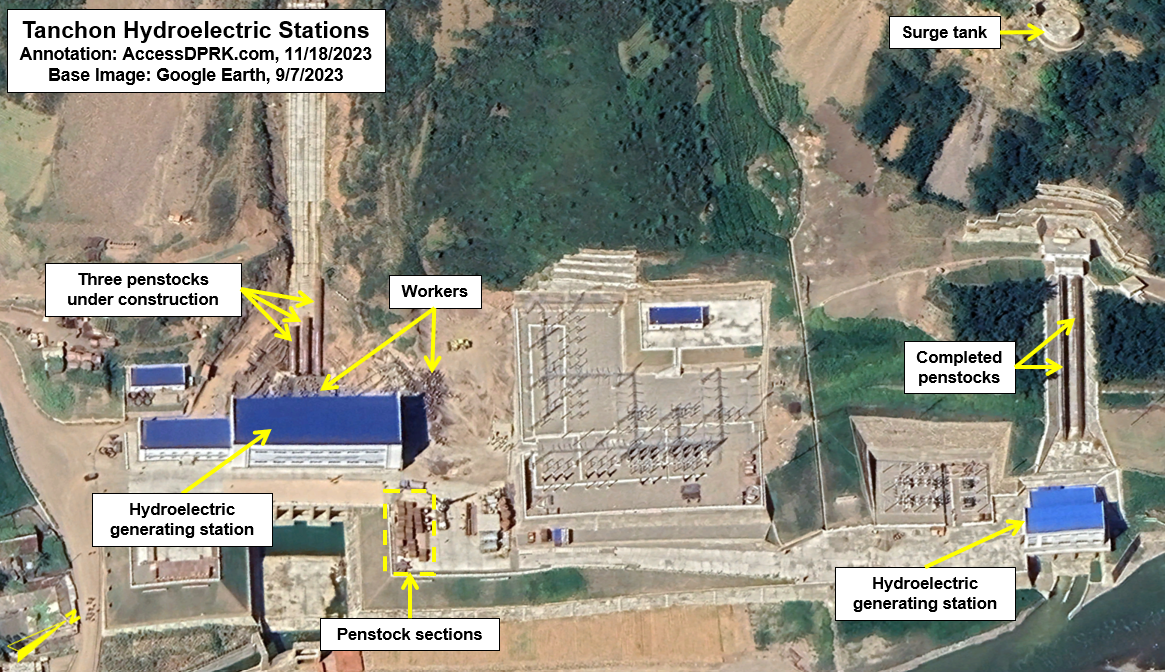
Plans to harvest energy from the Hochon River date back a century, but this latest endeavor began in 2017. With 60 km of tunnels, it's the largest hydroelectric project currently underway in North Korea. 

However, material shortages are a perennial problem on major projects in the country, and, made worse by the pandemic and border closures, the Tanchon Hydroelectric Project (40.787244° 128.444679°) still remains unfinished after six years. 

There was little noticeable progress made in 2022, but in the most recent Google Earth imagery, not only can progress be seen on the large penstocks, but crowds of workers are identifiable as well.  

Status of the Tanchon Hydroelectric Project as of Sept. 7, 2023.

If the penstocks are the final piece to the project (meaning that the generators are already in place), then Tanchon could come online in 2024, providing several megawatts of electricity to this key mining region. However, if North Korea hasn't managed to import or manufacture the complex turbine blades and generator components, then Tanchon may continue to sit idle for an indefinite period of time.


Despite the headway made at these two sites, there are still several others where no noticeable progress has been made, including on the Pyongyang General Hospital and the Wonsan Resort. The primary construction at both sites was completed over a year ago, but the government has not been able to acquire the necessary medical equipment and resort furnishings, leaving the sites as visible reminders of the government's overall inability to meet its own deadlines on some of its most publicized projects. 


I would like to thank my current Patreon supporters who help make all of this possible: Alex Kleinman, Amanda Oh, Donald Pierce, Dylan D, Joe Bishop-Henchman, Jonathan J, Joel Parish, John Pike, Kbechs87, Russ Johnson, and Squadfan.

--Jacob Bogle, 11/20/2023

Sunday, October 29, 2023

Inside North Korea 2023

As has become tradition with each new map release, here is a list of what's inside North Korea. Although this only reflects what the 2023 Pro Map captured, with over 70,500 sites mapped and organized into 100+ different types of location, AccessDPRK has sought to locate and describe every important military, economic, and cultural site within North Korea. 

This latest release also gives me the opportunity to discuss in greater detail what the map contains as well as describe the improvements between this version and the 2021 version.


Without repeating the full backstory to AccessDPRK (which can be found throughout the blog), I began mapping the country in late 2012 as a hobby. Since then, it has ballooned into a methodical mapping project with this associated blog to share the various findings in detail. 

The AccessDPRK blog currently has 167 articles which would take up around 1,160 printed pages. I have also written for several other sites including NK News, Asia Times, and 38 North, and AccessDPRK discoveries have been reported on or cited by Radio Free Asia, Voice of America, DailyNK, UPI, Asahi Shimbun, Nikkei, The Atlantic, RAND Corp., and numerous others.

I've also been able to provide professional services to nearly a dozen of the top human rights, nonproliferation, and GIS organizations in the world.


Within the 2023 Pro Map update, more than 70,500 sites are included. This is a net increase of over 17,000 sites compared to the first free nationwide map that I made available back in 2017, when considering all the different changes that have occurred since.

With this update, I have tried to focus on mapping out changes specific to Kim Jong-un's rule as well as monitoring the evolving infrastructure changes due to COVID-19.

As with all my North Korea maps, the file is organized into four main divisions: monuments, military, domestic, and nationwide. The item counts that I've added further below gives even more details, but the general organization of the map is as follows.

The monuments folder is broken down by province and includes folders for Towers of Immortality and a folder for all other monuments. Many of the locations have notes on the type of monument they are (mural, statue, etc.) as well as dates for their construction.

The military folder is broken down by province and there is one for the DMZ. In total, there's over 40 subfolders for specific types of places like anti-aircraft artillery positions, navy bases, military storage sites, tunnels, etc. 

The domestic folder is broken down by province and also contains over 40 subfolders for specific types of places like dams, electrical substations, factories, markets, elite housing, schools, train stations, etc.

Both the military and domestic provincial folders also have an "uncategorized" subfolder that contains numerous other sites of interest that didn't warrant having their own dedicated folder (typically because there were just a handful of sites). And, most provinces also have at least one other folder that contains places unique to that province.

For the nationwide folder, that contains ten categories of places that I felt were better organized together instead of being spread out among each provincial folder. Nine categories would be considered "domestic" and one (the folder for ballistic missile bases) would normally be in the military folder.


Compared to the 2021 Pro Map, this update is only 9% larger; however, there were several thousand internal changes to existing sites along with the 9% of newly mapped ones. I go through some of those specific changes below.

Monuments


The 2023 Pro Map includes 711 additional monuments over the 2021 version. This is largely due to updated imagery compared to what was available at the end of 2020, when I was finalizing the 2021 map (released that January). But there are also examples of monuments being constructed throughout 2021-23 (and those construction dates are included). I was also able to remove a few monuments that had been demolished, and to move the position of the icon for several other monuments that were moved to new locations. 

Additionally, and this goes for the military and domestic sections as well, I tweaked the position of hundreds (if not more) of icons to address the "drift" that happens when Google Earth updates its imagery. The images are rarely laid along the precise same coordinates so, after a few years, the Google Earth icon's position may no longer exactly match the position of the object in the image - sometimes by as much as 10 meters. So, I tried to make as many of those corrections as possible.

In the process of updating the monuments folder, I noticed some clear construction trends and periods of greater building activity. I've already written two detailed reports (2019 and 2021) on the monuments in North Korea, but I may write one last one in the future that will discuss these observations in more detail.


Military


The 2023 Pro Map only has 233 net additional military locations compared to 2021, but there were quite a number of other changes to the folder.

For one, roughly 40 anti-aircraft artillery sites in the 2021 map were reanalyzed and determined to not be active sites, so they were recategorized as "decommissioned" and moved into that folder. 
Several new AAAs that were constructed recently are also now included, making this the most up-to-date map of North Korea's air defense network.

Surface-to-air missile bases, which had been included in the same folder as AAAs, were separated out into their own folder. The exact type of SAM (S-75, S-200 etc.) was also added to those sites as well as information on the nine suspected mock SAM installations.

I reviewed the DMZ to ensure I located every pertinent site, and I took the opportunity to redraw the various fences so that they match the terrain more closely. 

The Airport file now includes known civilian "aviation clubs" and also reflects the fact that several airports and airbases have been demolished in recent years.

Within the rest of the folder, I added radar system identifications to dozens of sites and reviewed and improved the classifications of sites within the "possible units", "compounds", and "factories" folders. I also added additional data to "military units" and "tunnels" when available. 

Domestic


The domestic section ended up with the largest number of additions by far with 12.5% more sites than in 2021.

This is in large part due to COVID infrastructure, but I was also able to pick up on a number of new constructions, located formerly unknown sites, and I also added the country's network of forest management centers (located within the farming/agriculture folder), and improved the disposition of Pyongyang's water supply system - that alone added nearly 100 extra sites.

As for COVID. I remapped the entire northern border and both coastlines as North Korea began to rebuild and install new electrified fences along those areas to seal the country off. The 2021 map had positively identified 1,693 km of coastal and border fence (excluding the DMZ). The 2023 update has identified 3,684 km of new and modernized fencing. 

Along with the fences, I estimate that North Korea constructed an additional 15,000 border guard posts. To keep myself from going crazy mapping each and every one of those, I have picked a representative sample by mapping random ones. Nonetheless, 4,575 guard posts and guard barracks are individually identified within the map.

Additions based on COVID infrastructure continue through the discovery of COVID isolation facilities built throughout the countryside (109 are presently located), and the discovery of an anti-pandemic barrier that's being built around Pyongyang. The barrier alone accounts for 320 new sites. 

Some of the other changes include 47 additional dams and weirs, 56 additional communication towers, 35 additional electrical substations, 26 newly identified marketplaces, 185 extra farming/agricultural facilities, 41 extra schools, 18 additional historic sites, 38 extra gas stations, and around a dozen newly identified prisons/detention centers. 

Among all of this, I also moved ~1,200 sites (of all types) out of the Pyongyang folders and into folders for North Hwanghae and South Pyongan provinces because Google Earth finally got around to correcting their borders. And, roughly 800 sites had additional information added to them such as construction dates, notes on renovations and major events, and relevant news links.


Notes: 

I want to add a few notes to help with context and prevent any confusion.

While most of the categories are indeed individual sites (there are 1,520 distinct electrical substations for example), some of the categories include not just the primary location but also sites within those places. A great example of this is that there are not 434 prisons in the country. There's 67 known, suspected, and former prisons that I was able to locate. And many of those prisons include detailed maps that also mark where the guard huts are, where prisoner housing is, and so on. So, one prison may be represented by 20+ items, and that's how I get to 434 total sites within the prison category.

The categories that have these more detailed folders are prisons, missile bases, some historic sites, several of the "elite compounds", and a few factories. Additionally, some of the "province only sites" include multiple sites per place. This is especially true in Pyongyang which has the most of these province-only sites. An example is the Ryongsong Residence, which located within the "province only" folder, but that one residence includes 47 detailed sites within its folder. So, while there are 1,043 markers within the whole "province only" category, they're only representing ~300 primary places as several of those primary places have numerous sites marked within.

Lastly, in some cases I did not try to map every single one of the sites within a category. There are notes in the respective folders saying this, but they are: irrigation pumping stations, water supply, factories, agricultural sites, internal security checkpoints, parks, and gates. I tried to map a majority of sites and all of the important ones with the exception of the water supply sites, agricultural sites, internal checkpoints, and gates. For those, I wanted to give a representative sample and to locate major places. I only marked gates in cases where a facility was large and the main entrance could be difficult to find, and in cases where the gate itself was interesting/large.


I would like to thank my current Patreon supporters who help make all of this possible: Alex Kleinman, Amanda Oh, Donald Pierce, Dylan D, Joe Bishop-Henchman, Jonathan J, Joel Parish, John Pike, Kbechs87, Russ Johnson, and Squadfan.

--Jacob Bogle, 10/28/2023