Saturday, January 15, 2022

Kim Jong-un's First Decade in Power - Health of the Man

Note: this was originally going to be a single article detailing healthcare in North Korea, with the first half being on the health of Kim Jong-un and the second half focusing on the general state of healthcare and medicine in the country. However, due to length, I have decided to split the article into two separate ones, divided among the same two topics: health of the man and health of the nation. "Health of the Nation" will be published in the upcoming days. 


Sensationalized headline by the celebrity gossip website TMZ repeating totally unfounded claims that Kim Jong-un may have died in April 2020. Image: Screenshot of April 25, 2020 ‘breaking news’ article headline.


Introduction

   The health of a nation’s leader and the health of the population are two factors that can have an outsized role in determining the course of history, yet it is often overlooked. Immediate, visible existential threats like invading armies or economic collapse occupy far more of a government’s attention, while invisible germs or quietly ticking clogged arteries remain out of sight and all too often out of mind.

However, history is filled with the turning tides of war, the rise and fall of empires, and revolutions that are either partially or largely based on matters of health.

U.S president Woodrow Wilson suffered a stroke in 1919 that severely hampered his ability to promote the League of Nations Treaty within the United States, leading to its ultimate failure in the Senate. Without the support of the United States, the weakened League’s ability to enforce its own resolutions and maintain future peace enabled the Italian invasion of Ethiopia, Japan’s invasion of Chinese territories, and eventually lead to the Second World War as Germany began to systematically violate treaties and ignore post-WWI obligations.

Adolf Hitler’s continual drug use after 1941 fueled his innate sense of infallibility and compounded his manic episodes. Coupled with his lack of military knowledge, his addled brain brought about some of the greatest military disasters in history.


   While the leaders of North Korea are painted in semi-divine terms by state propaganda, they are, in fact, just men. Kim Il-sung died of heart failure. Kim Jong-il suffered a major stroke and then died of a heart attack three years later.

And even though Kim Jong-un came into power at a young age, his health then as now has been the subject of much discussion and concern. The illness of any leader can cause instability within a country, and as Kim currently lacks any adult heirs, an unpredictable succession could have major consequences both domestically and internationally.

Surgeries, long periods of disappearance, and even rumors of his death have dogged his first ten years in power.

As such, while Kim Jong-un can boast some legitimate accomplishments in other areas, the history of his first decade with regard to his own health can only be given a middling score.


Health of the Man

Kim Jong-un with his walking cane visible in this KCNA image dated Oct. 14, 2014.

   Nearly everyone can find some genetic history of illness in their family. Heart disease, cancer, dementia, these things are common to have in your family. But most people manage to live long, healthy lives regardless and one’s lifestyle plays a huge role in this.

For Kim Jong-un, heart disease runs in his family. It’s also likely that other conditions like high cholesterol and atherosclerosis affected both his father and grandfather, but we have little direct evidence of this.

As a teenager, Kim’s lifestyle would have placed him on a better health footing than genetics may have suggested. He was athletically inclined, loved playing basketball (even had an aggressive streak), and he enjoyed spending time at the family’s seaside villa at Wonsan which offers multiple types of recreation.

But as he got older, he began to put on weight and when he came to power at the age of 27, he may have weighed as much as 90 kg (198 lbs) while being 5’ 7” tall. This would have given him a body-mass index (BMI) of 31, making him clinically obese.

Both his predecessors also put on weight as the years wore on, fueled by extremely rich foods and copious amounts of alcohol.

Kim Jong-il once remarked that he didn’t trust people who wouldn’t get drunk during parties. And he was known to be Hennessy’s largest non-corporate customer, importing $700,000 worth of Paradis cognac in one year alone to keep himself and his friends suitably lubricated.

This raises the specter of alcoholism within the family as well which would compound any predisposition to other illnesses. I don’t mention alcoholism just because Kim Jong-il enjoyed parties, but because his sister (Kim Jong-un’s aunt), Kim Kyong-hui, has struggled with the disease for many years and because alcoholism is known to be common among North Korea’s elite.

There is little to suggest that Kim Jong-un does not enjoy an equally spiritous lifestyle.

Pointing to this is the theory that Kim suffered from gout in the early years of his reign. After being out of the public eye for forty days, Kim Jong-un appeared in public again on Oct. 13, 2014 but needed a walking stick to help him get around.

South Korean intelligence said that he had undergone a procedure on his foot; however, that belies what could have been a more complicated truth.

Media commentators and North Korea watchers speculated that he was more likely suffering from gout, a condition where uric acid builds up in the joints and causes a wide range of painful symptoms. Major contributing causes to gout include having a diet high in fats and sugars, drinking, and smoking.

Gout can also cause tophi, hardened deposits of uric acid on the joints. One place they tend to develop on is the Achilles tendon.

Kim continued to use the cane for three weeks.

Of course, none of this is conclusive that he had gout and it’s never a good idea to do armchair diagnoses, but it is one reasonable possibility to explain why someone with his history and lifestyle would also need a cane for weeks.

What is known without doubt is his family history of heart disease and stroke, and that he is obese, eats an unhealthy diet, smokes, and has a history of minor surgery.


   Kim’s smoking is both a family trait and a national pastime. Some 46.1% of North Korean men smoke cigarettes daily, compared to 15.3% in the U.S.

Kim has tried to stop smoking at least twice, in 2016 and in 2020. Each of those years was also times when the regime promoted anti-smoking campaigns. In 2020, Kim actually banned smoking in public places.

The issue of Kim’s smoking even came up during a March 2018 meeting with South Korea National Security Advisor Chung Eui-yong, as Kim’s wife, Ri Sol-ju, said she had been wanting him to stop smoking for years. Unfortunately, smoking can be a very hard habit to break and he is still seen with a lit cigarette in many of the official photographs released by state media.


A portly Kim Jong-un walking around Ryomyong Street in Pyongyang. Image: KCNA, Jan. 26, 2017.


   By 2015, his weight had further ballooned, possibly to as high as 130 kg (286 lbs), giving a BMI of nearly 45. This level of weight gain, if the estimates are accurate, would drastically increase his risks for developing diabetes, liver steatosis (fatty liver) – made even worse by drinking alcohol – and would require his heart to work harder, almost certainly leading to heart disease at a younger age.

Making understanding his health situation more difficult is that speculations on the health of the Kim family, replete with lurid tales about their lifestyles, have long been fodder for tabloid writers and intelligence agencies alike. Western reporters often lack translators (or perhaps just the discipline) to correctly divine whether or not a story is coming from a satirical online discussion board or is legitimate breaking news, and foreign intelligence agencies lack the resources required (both human and electronic) to get close to the leadership to validate or refute every rumor that pops up.

South Korean media, in particular, have an unfortunate reputation for getting things wrong when it comes to North Korea or for taking a mere suggestion from an “unnamed intelligence officer” and running with it as though it were the gospel truth.

There have been numerous examples where stories of one or another North Korean official is reported to have been executed – with no substantial evidence, and then the story gets copied and repeated in otherwise legitimate media around the world only to have said official show up days or months later.

And things haven’t been any better regarding reporting on Kim Jong-un. In 2016 a baseless rumor about his death was picked up and reported as fact. Such shocking news caused defense stocks to temporarily rise and the South Korean won to fall.

The fake story even claimed that the Korean Central News Agency had announced the news. All anyone had to do was to check the KCNA website. Absolutely no such official story existed. And yet, by the next day, 115 articles had been written on the topic and it began to make the rounds internationally.

Needless to say, Kim wasn’t dead. But this highlights the dangers of not checking sources first and exchanging one’s journalistic standards to post sensational and clickbait-y stories.

Unfortunately, such lessons never get learned.


   In 2020, Kim Jong-un was not seen visiting the Kumsusan Memorial Palace (Kim Il-sung’s and Kim Jong-il’s mausoleum) for the April 15 Day of the Sun ceremony, the country’s most important holiday. It was the first time he missed taking part in the ceremony since coming to power.

Missing such an important event sparked many questions. Soon after, DailyNK reported, based on an unnamed source inside North Korea, that Kim Jong-un had undergone a heart procedure at the exclusive Hyangsan Hospital on April 12 and was recuperating. It gave few other details but was clear in that Kim was stable and resting at one of his villas.

It wasn’t long after this that other reports started claiming he was in critical condition, brain dead, in a coma, and even dead. Many of these false reports claimed to be citing DailyNK, even though nothing in the DailyNK article could be construed to mean he was near death.

This absolute journalistic negligence didn’t even stop when 38 North reported, with clear satellite images to back it up, that Kim Jong-un’s armored train had been sitting at Wonsan Palace since April 21 and reports by others that leisure boats from the palace had been moved around the bay. The combination of evidence made it almost certain that Kim Jong-un was not only alive but had moved from Pyongyang to spend the rest of his recovery time at his favorite residence.

The rumor mill didn’t finally stop until both U.S. and South Korean officials came out and said they agreed with the assessment that he underwent a medical procedure and that he was alive and there were no indications of anything more serious.

Kim finally reappeared in public on May 1 during the official opening of the Sunchon Phosphatic Fertilizer Factory. There was continued speculation about his recovery, but as Jefferey Lewis remarked on Twitter, “Well, I wouldn't say Kim looks healthy, but he definitely doesn't look dead.”

All three Kim’s have disappeared from view on multiple occasions, but those periods don’t always concern ill health. The birth of a new child, taking vacations, or simply needing time to reflect on new policies can drag even the most spotlight-loving dictator away from making daily appearances.

However, there has been one other recent absence that did restart discussions about his health.


   After missing for a few weeks, Kim Jong-un oversaw a parade celebrating the country’s 73rd founding anniversary on Sept. 9, 2021. The nighttime parade offered a lot for observers to discuss (like the inclusion of civilian emergency personnel) but it was Kim Jong-un’s physical appearance that also caught attention.

He had lost a noticeable amount of weight and had an overall better look and energy level than in the past. Further appearances substantiated the initial assessment that he had, indeed, lost significant weight.

It was first reported that he may have lost between 10 and 20 kg (22-44 lbs.). More recent images of him at the end of 2021 places the weight loss at the higher end of that estimate and also show that he is managing to keep the weight off for now. Although he would still be considered obese for his height (his thinner weight is still between 117 and 120 kg (258-264 lbs.)), it is a good start.

His mobility and breathing have visibly improved as a result as well.

The weight loss doesn’t only have a positive impact on his health, which seemed to be deteriorating over time. Particularly after the DPRK-US summit process collapsed and as North Korea faces tremendous economic problems due to COVID-19, Kim must be seen as a vigorous leader. His “on the spot guidance” tours, pioneered by Kim Il-sung, are an integral part of his rule, and the only way to keep such an active touring schedule is to maintain a certain level of health.

Additionally, gossip within North Korea by average people about his weight had increased over the course of his first decade. Even though such talk against the “highest dignity” is illegal, gossip, jokes, and criticisms about him routinely spread. In a country of chronically undernourished people and after he raised the specter of additional “belt tightening”, being caricatured as the plump Supreme Leader poses a threat.

These concerns over the people’s opinion of Kim have not just shown up in secret government meetings. State media has publicly addressed his weight loss, implying that Kim was eating less to help the country, harkening back to the days of the famine when Kim Jong-il was reputed to only eat a single bowl of rice a day. So, his thinner look pays both political and health dividends for the leader.


   The leaders of North Korea are no different than any other person in their desire to live as long as possible, but they do have far greater resources to apply to accomplishing that. To reach for that goal, a secretive research organization was established during the rule of Kim Il-sung, the Longevity Research Institute, to help keep him happy, healthy and living as long as possible through the use of herbal and folk medicine mixed in with modern medical science (along with practices of questionable ethics and effectiveness).

The Institute continued its activities throughout the life of Kim Jong-il, with 130 doctors and scientists eventually being involved. While there has only been indirect evidence that the Institute is involved in Kim Jong-un’s life, it is likely they’re working hard to keep the third generation of Kim going.


   With all of the real (and imagined) health problems Kim Jong-un has faced, governments and pundits around the world have been contemplating his eventual death. What would the aftermath of his sudden death mean? Can there be yet another dynastic succession? What about who controls the nuclear weapons? Who could maintain internal stability?

These and other questions were all raised during his 2020 absence and literally thousands of articles and reports were written to try to answer them.

I myself wrote three. One for AccessDPRK, one as part of a digital symposium by The National Interest, and one discussing the future of the Kim family cult after his death for Asia Times.

The opacity of North Korea’s governing system and a lack of knowledge about any official succession or continuity of government plans renders discussions about Kim Jong-un’s incapacitation or death little more than speculation, but his health must be considered to be part of North Korea’s national security planning. And until his children reach adulthood, there will be an extra layer of doubt and concern over his health and what might happen in the future.


Conclusions

   With no clear heir, the status of Kim Jong-un’s health does become more pressing. Although Kim does not engender the same devotion and loyalty as Kim Il-sung, and although it is unlikely that he has the same level of absolute control over the state as previous generations of Kim have held, Kim Jong-un is still the center spoke for a nuclear-armed nation.

With the family medical history such as it is, his recent weight loss could be the first concrete sign that his health has been precarious, and that he is now taking steps to ensure his survival and the continuance of the regime.

There are also hints that Kim has begun to make subtle reforms to the country’s laws and to the rules of the Workers’ Party that would theoretically enable someone other than him or a direct heir to one day rule the country. These changes may only be temporary steps to shore up the regime in the event of his demise, changes that could be reversed once an official successor is named, but they are nonetheless incredibly important and exhibit a level of foresightedness in the face of his medical history.

To directly address Kim Jong-un’s health, his surgeries point to a relatively young man that may be facing some serious medical issues. His weight loss is a concrete step toward warding off everything from heart disease to diabetes, but he will need to go further still. He must eventually stop smoking and his diet is going to have to change substantially if he wishes to live – healthily – into his 80s.

Another move would be to lower his stress levels. Genuinely placing focus on the people’s health and wellbeing and working to finally solve longstanding issues like food shortages would benefit Kim and the 25 million others living in North Korea. Of course, if history is any guide, this is unlikely.


~ ~ ~ ~

I have scheduled this project to run through to the end of the year, with a new article coming out roughly every 10 days or so. If you would like to support the project and help me with research costs, please consider supporting AccessDPRK on Patreon. Those supporters donating $15 or more each month will be entitled to a final PDF version of all the articles together that will also have additional information included once the series is finished. They will also receive a Google Earth map related to the events in the series, and can get access to the underlying data behind the supplemental reports.

Supporters at other levels will be sent each new article a day before it’s published and will also receive a mention as seen below.


I would like to thank my current Patreon supporters: Amanda O., GreatPoppo, Joel Parish, John Pike, Kbechs87, and Russ Johnson.

--Jacob Bogle, 1/15/2022

AccessDPRK.com
JacobBogle.com
Facebook.com/accessdprk
Twitter.com/JacobBogle

Monday, January 3, 2022

AccessDPRK in 2021

This last year marked a milestone for AccessDPRK, and thanks to your continued readership and the support of my Patreon supporters, 2022 will see some great additions to the project.


The biggest event of the year, of course, was the publication of the Phase III map.

The journey that led to the 2021 map began in December 2012, and after 7,000 hours of work, I was finally able to publish the final version of this nationwide map. 

The Free Version contains over 61,000 locations of interest. The Pro Version includes an extra 3,400 locations along with added information on thousands of others. In terms of locating military bases, industrial facilities, and cultural sites, it's the most comprehensive map available to the public...anywhere.


For the AccessDPRK blog, I was able to write 21 articles and analyzed 116 images for those articles. I also started the Kim Jong-un's First Decade in Power biographical series which takes a look at his first decade ruling the country. The series is broken down into twelve topical articles and eight have already been published.

The top 5 articles of the year were:

  1.  What's Inside North Korea?
  2.  Is Wonsan Prison No. 88 Closing?
  3.  What Lies Beneath the Underground Republic
  4.  Border Blockade
  5.  The Unique Buildings of NK's Missile Program
AccessDPRK articles were also cited by Chosun Ilbo, One Earth Future Foundation, i News and various other UK papers.

The blog's 142 articles now contain the equivalent of 937 printed pages of material and include 938 images. I also added 65 images this year through Twitter that are not duplicated in the articles on this blog. In total, I've added nearly 500 Twitter images, providing a very large range of visual material for those interested. 

Web traffic to the site increased by nearly 20% year-over-year. On Twitter, I added 185 new followers and AccessDPRK-related tweets earned 346,000 impressions. The year's most 'popular' tweet was one in response to North Korea's September 2021 cruise missile test and reported range.


As announced at the start of 2021, I also began working on a book. Thanks, in particular, to my Patreon supporters I was able to purchase several books and journal articles to help research for mine. The future book's current layout is broken down into three main sections and will contain seventeen chapters. Of course, this is subject to change.

 
Looking to 2022

The amount of work required to research and write the biographical series necessitated that I largely take a break from other parts of AccessDPRK, but once the series is finished, I will be focused on completing the watershed map and the map of DMZ trenches. I will also work toward editing and publishing the rest of the 31 'city briefs' that I have written on various towns across the country.

Afterward, I would really like to place more focus on research and writing my book. Although that may mean less blog activity, I will still be looking out for new changes in North Korea and if a topic piques my interest, I'll write a post about it. I currently have a list of 20 article ideas & drafts, so there shouldn't be a dramatic decline in regular content output. It just won't be my main focus.


Patreon

I set up a Patreon account in 2020 and have gained some great supporters. Currently, you can help support the project for $3, $5, $10, $15, and $20 monthly, each coming with its own rewards.

I am constantly thinking about new rewards to add, one of them being that I am working on a kind of virtual tour of the country. But you can already get early access to new articles, monthly digests that feature information I haven't discussed publicly, you can have me analyze places you're interested in, and get access to multiple exclusive datasets. Plus, blog and Twitter mentions for any support at $3 or more.

If you believe in sharing facts-based information with the public about all aspects of North Korea (defense, culture, economy), please think about helping out. Every dollar really does help make this possible.

With that, I want to give a huge THANK YOU to my Patreon supporters throughout the year: Amanda O., Anders O., GreatPoppo, Joel Parish, John Pike, Kbechs87, Planefag, Rinmanah, Russ Johnson, and ZS.

Lastly, I want to wish everyone a wonderful upcoming year!


--Jacob Bogle, 1/2/2022
AccessDPRK.com
JacobBogle.com
Facebook.com/accessdprk
Twitter.com/JacobBogle
Saturday, December 25, 2021

Update on the Pakchon Uranium Mill

The Pakchon Uranium Concentrate Pilot Plant is the first uranium concentration plant in North Korea and is one of only two known to exist, the other being the Pyongsan plant

Operations at Pakchon take uranium-bearing ore (usually from coal) and concentrate it into 'yellowcake' which has a uranium concentration of 99% pure U-238, a low radioactivity, long half-life form of uranium. From here, it is sent to other sites (such as Yongbyon) where it is converted into highly enriched U-235 which can be used for bomb production.

However, its operations have been scaled down and it has been in caretaker status since perhaps as far back as 2002.

But although uranium production has been shunted to the more modern Pyongsan, Pakchon's caretaker status certainly doesn't mean abandoned. Recent satellite imagery suggests at least some limited operations are still ongoing and that the regime has been fairly active in maintaining the complex. The continued importance of Pakchon in the country's nuclear program is evidenced by the fact that the United States was interested in having it permanently closed and dismantled as one of five nuclear facilities offered up by North Korea in exchange for sanctions relief. 

When I first wrote about the site in 2019, I noted two buildings that were either being demolished or that had been left to fall apart. Since then, commercial satellite imagery from Sept. 14, 2021 shows that one of those buildings has been completely reconstructed. Additionally, a repaired section of roof on the main milling building can be identified.

The imagery also shows that the complex's administrative section has seen construction and that the waste material reservoir is still being used.

The nearby mine that provides uranium-bearing ore has also been continually active. Whether it's sending its full production to the Pyongsan Uranium Mill or diverting small amounts to Pakchon, I can't say, but the improvements made at Pakchon suggests that the ore from the mine would likely one day be sent back to Pakchon if it becomes reactivated in the future.


Taking these changes one-by-one, the first I'll talk about is the reconstruction of the thermal building which provides extra electricity for the plant. 

Thermal plant as seen on March 19, 2012.

In the above image from 2012, the thermal plant complex is clearly visible. Coal is housed in the bulk storage building where it is then moved uphill via a conveyor belt to the generating hall. The coal ash is then dumped outside of the building in a pile next to the conveyor where it accumulates until removed.

In 2019, the generator hall was being demolished.


By October 2019, the generating hall had been torn down to its foundations.

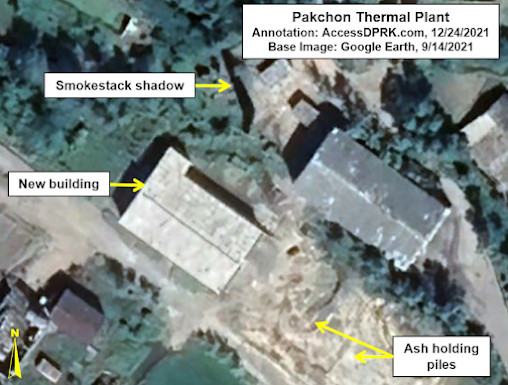
There is a gap in the Google Earth imagery, but by September 2021, a new structure can be seen.


The absence of a conveyor system, either above or below ground, suggests that construction to modernize the plant may not yet be complete.

Nearby are two other unidentified support buildings that have been left to fall apart.

Building #1 has a partially collapsed roof while building #2 is missing its roof entirely.


In this image, from right to left, you can follow the production process as described by the Center for Strategic International Studies.

The September 14, 2021 image also shows that a section of roof has been repaired in the section of the production building that is responsible for drying and filtering the yellowcake uranium before it is shipped out.


Pakchon's waste reservoir is split into two reservoirs, an upper and a lower one, divided by an earthen dam. The area of the reservoir that is filled with waste is approximately 3.4 hectares, with the upper section usually being filled with water and the lower section containing sludge and newer waste materials.

While the size of the reservoir hasn't changed in at least 17 years, the sludge pool has seen continued activity, particularly in the last few years. 

Beginning in 2019, a new staging area was constructed to accommodate vehicles and other equipment involved in the management of the reservoir. The staging area covers roughly 2,900 sq. .m. 


One other section of the Pakchon complex that has seen recent activity is in the administrative area. In 2019 a new theater/assembly hall was constructed over the course of the year.

The new hall is on top of substantial construction work that happened between 2008 and 2012, when nearly every current structure visible was either renovated or added.

Additionally, the fish farm that exists next to the administrative area had more modern facilities built in 2019-2020. These fish farms can be found throughout the country and help provide needed protein to local workers, military personnel, and the fish can even be exported to earn the country foreign currency.  


While none of this activity suggests full-scale operations have resumed at the concentration plant, it does support the idea that, like Punggye-ri, the site remains part of the country's nuclear program and may be ready to resume limited production should the order come.

As Joseph Bermudez wrote for CSIS back in 2019 about the low-level activity that can be observed, "the most likely explanations for this activity would be small processing runs of iron-bearing ore of some type, caretaker maintenance work, or decommissioning of equipment within the plant." 

However, with the newer imagery and changes, I would like to suggest that some of the activity could be part of pollution mitigation efforts or reprocessing older ore/waste material to extract small amounts of formerly discarded minerals (an activity seen at certain mining sites in recent years).


I would like to thank my current Patreon supporters: Amanda O., GreatPoppo, Joel Parish, John Pike, Kbechs87, Rinmanah, and Russ Johnson.

--Jacob Bogle, 12/24/2021
AccessDPRK.com
JacobBogle.com
Facebook.com/accessdprk
Twitter.com/JacobBogle

Wednesday, December 22, 2021

Kim Jong-un's First Decade - A Decade of Market Growth

This is the fourth and final of the supplemental articles for the Kim Jong-un's First Decade in Power series. It details the various infrastructure changes and weapon developments of North Korea's conventional forces over the last decade.

Undated image from the North Korean government (via Naenara.com) of the interior of a marketplace in Pyongyang.

Introduction

Modern markets in North Korea trace their history back to the chaos of the famine of 1994-98 that killed upwards of 1 million people through starvation and related diseases.

As the central government’s ability to feed the people through the Public Distribution System failed (previously a citizen’s primary source of food), people had to make the decision to either abide by state ideology and starve or they could take matters into their own hands.

Since the vast majority of men were either serving in the military or still forced to report to derelict state factories for “work”, women took the lead and created the foundations of today’s market system that has spawned an entirely new generation, the jangmadang generation (those who came of age after the famine and during the period of marketization).

What began as highly illegal activity in the black markets has, twenty-three years after the famine, evolved into a series of legal and quasi-legal markets that has resulted in an entire generation never knowing reliance on state rations and who are unlikely to give up that freedom (and a greater selection of goods) to go back to the old days of the Public Distribution System’s monopoly.

The evolution of markets has weakened the regime’s internal travel restrictions and prompted an interest in entrepreneurship that can be seen in the creation of private transportation companies and a booming housing market, enabling the development of a middle class for the first time in North Korea’s history.

The regime has grappled with this loss of control through cracking down on market activity and, at times, trying to bring it under central authority by giving it a level of legitimacy (particularly in Kim Jong-un’s first several years as leader). But while Pyongyang is still trying to adapt to the reality that markets are likely here to stay, the wheels of commerce have not stood still. Today there are at least 477 markets throughout the country providing everything from rice and corn to home goods, foreign entertainment, and medicine.

Although there has been considerable research into early market development and its impact on people’s lives, I want to take this opportunity to show the growth arc of markets over the last decade and to reiterate that, absent the recent effects of COVID-19, market activity has not stalled or reached a saturation point but remains a dynamic economic force both because of and in spite of the regime.


A quick note: I have tried to tailor this report to focus on the markets and on how economic policies have affected them. More details and a broader view on economic policy under Kim Jong-un will be the focus of an upcoming regular article of the series.


Early Policies under Kim Jong-un

Perhaps due to his preoccupation with consolidating power or perhaps because he realized the state still couldn’t be the sole provider of people’s needs as in the days of Kim Il-sung, Kim Jong-un initially took a wait-and-see approach to the markets with the occasional foray into reform.

Exactly how open he was to reform is up for debate, but there is clear evidence that he was not only willing to continue the tacit approval of the growing market economy as his father had been forced to in the wake of the famine, but he was also willing to become the first North Korean ruler to implement market-oriented reforms (at least for a time) that positively affected the average person.

The government has tried to integrate the market economy into the centralized command economy by allowing the markets to exist while taxing them and regulating the kinds of goods that are allowed to be sold. As Prof. Andrei Lankov summarized in his 2016 report The Resurgence of a Market Economy in North Korea, “The government’s approach to the private sector has been mixed. It generally accepts private enterprise as a necessary evil, but for political reasons, it is not prepared to legalize it completely. Kim Jong-un’s government is more tolerant of private enterprise than its predecessors.” However, “the outright legalization of the private sector appears unlikely.”

Kim has also sought to compete with the markets by modernizing an ever-growing number of state-owned department stores. While these stores are not part of the ground-up marketization that has spawned hundreds of trading locations across the country, they have helped to fill a need for those who have managed to make it into the monied-class through private economic activity, particularly in Pyongyang.

With this mix of private and state options that currently exist, those with enough disposable cash can have access to bulk rice and illegal South Korean TV shows via the trading stalls and can then go purchase $1,000 designer handbags in department stores – with the added bonus of not risking getting arrested as the store's products are fully sanctioned.

But legitimizing the markets themselves was only one part of the economic puzzle that has led to a relatively robust market economy.


Chart showing the relative stability of the black market value of the North Korean won prior to the COVID-19 trade restrictions. Image source: DailyNK/Bloomberg.

The government has also taken a lax approach to the black market exchange rate of the won. Officially, 100 won is roughly equal to $1 USD, but in the markets, it’s well over 5,000:1.

Instead of instituting more disastrous currency reforms as it did in 2009, it has allowed the black market rate to serve as the won’s true indicator of value while being more aggressive in regulating the use of foreign currency. So, people have been able to save and invest using the North Korean won and those savings have not been at risk of arbitrary confiscation or a dramatic devaluation at the hands of the central bank in years.

This sense of stability has further strengthened the marketization process up and down the entire system.

In 2012, in one of Kim’s first major economic changes, he allowed farmers to keep their surplus produce to sell or trade and to keep any profits. Prior to the famine, selling food from state-controlled farms was highly regulated. Now, farmers would have incentives to keep working on government farms (instead of leaving to tend to their own illegal plots). Under this plan, improving agricultural output to alleviate food shortages was the state’s goal. However, it had the secondary effect of filling the markets with more and more foodstuffs and enabled farmers who’d otherwise be forced to rely on less than $15 a month in wages to earn enough money to live and not merely subsist.

Initially, it was projected that (so long as they met state quotas) most farmers would end up being able to sell 30-50% of their harvest in the markets. Enabling food to be sold and distributed locally is also highly beneficial during times of food scarcity as it improves the efficiency of distribution and ensures supplies still exist even as prices rise.

With the addition of new initiatives by the regime to dramatically increase the allowed size of ‘kitchen gardens’ from 100 sq. m. to 3,000 sq. m., by 2015, data from the UN Food and Agriculture Organization and anecdotal reports from within the country seemed to show that these early reforms by Kim Jong-un were bearing fruit.


Another major part to why markets continued to thrive has been the end of the Songun (military-first) policy. Instituted by Kim Jong-il to give the military a greater role over economic planning and the prioritization of resources when the regime saw itself under extreme external threat, the policy created massive distortions in the economy and diverted needed investment away from light industry and agriculture.

Kim Jong-un has worked to dismantle Songun in favor of his Byungjin Line or “parallel development” that seeks to pursue nuclear weapons without neglecting the domestic economy. A refocused approach to bolstering light industry and improving the quality of consumer goods has led to some improvements in the quality and diversity of available goods while also seeing factories in various sectors modernized.


Market Growth

In 2018 the Center for Strategic and International Security released a report on North Korea’s markets. Their reporting revealed that there were at least 436 officially sanctioned markets in the country and that the government received $58.6 million each year from stall rental fees and taxes.

Additional CSIS reports showed that a substantial portion of citizens earn at least 75% of their income from market activities. This finding fits well within what others have reported including New Focus International and defector testimony.

Based on the AccessDPRK Mapping Project (2021), this supplemental report provides an update on the number of markets in the country.

There are at least 477 markets in North Korea with 20 being identified as informal street markets and 457 being official markets. Of the official markets, some are still open-air sites with no permanent buildings. Because of this, it can be difficult to ascertain changes to the level of activity occurring there. So, I will only be focusing on the 441 markets that have permanent vendor stalls, as their construction and removal can be tracked across time, providing better direct evidence for the health of the economy in each city.

– A note on methodology, formal markets tend to have a defined boundary wall. Within that boundary can exist vendor stalls plus open ground for overflow capacity. Often, they include both. In cases where a substantial portion of the market is just open space, I have only included the areas occupied by stalls as the market’s “area”, as those stalls are responsible for most of the everyday economic activity that occurs and are the only thing that can be routinely measured. –

This chart shows the total area of the new markets constructed each year.

Since 2011, I have noted thirty-nine newly constructed markets. Of those with precise construction dates (there’s occasionally gaps in Google Earth imagery) two were built in 2011, four in 2012, three in 2013, five in 2014, four in 2016, three in 2017, five in 2018, six in 2019, three in 2020, and one is known to have been constructed in 2021. As this shows, there has been no real decline in the growth rate of markets over the course of the decade until the onset of the COVID-19 pandemic.

In 2011, 2,650 sq. m. worth of new markets was constructed and by 2019 that had grown to 23,260 sq. m. of additional market space. But that dropped precipitously following COVID-19 with only 7,450 sq. m. of space added in 2020 and just 630 sq. m. verified in 2021.

A further 114 markets have also grown in size since 2011. In total, there is 1,502,270 sq. m. (16,170,299 sq. ft.) worth of vendor stalls within the 441 market sites reviewed. That’s a net increase of 236,320 sq. m. (2,543,727 sq. ft.) since 2011. There are also tens of thousands of square meters in various overflow spaces outside of the main market buildings, but as these spaces aren’t always clearly delineated and often spill out into the streets or surrounding fields, trying to measure them can become somewhat arbitrary.

The largest single market in the country by area is the Sariwon market located in Kuchon-3 district (38.501407° 125.778737°). With at least 29,000 sq. m. of space, it’s over 8,000 sq. m. larger than the next largest market in North Korea. The market was constructed in a former stadium and includes a large central building surrounded by dozens of smaller structures that hold vendor stalls and other facilities.


Some other market-related stats are:

  • The newest market is in Hamhung. Constructed between 2020-2021, this small market (39.953089° 127.560062°) provides facilities to the growing districts around the Chemical Materials Institute and Tonghungsan Machine Plant.
  • There are 26 markets greater than 10,000 sq. m. in size.
  • There are 95 markets with less than 1,000 sq. m. worth of vendor stalls.
  • The smallest market (as best as I can determine using Google Earth measurements) is in the town of Hwaam (40.675307° 126.451652°) and only has ~130 sq. m. of active space. It does have some overflow area, but currently, there is just a small cluster of permanent structures.
  • Although it wasn’t until 2002 that the government allowed officially sanctioned markets to operate, based on the available Google Earth imagery, at least 56 market sites with permanently constructed buildings had already been in existence prior to 2002. These include markets in Anbyon, Sinpo, Wonsan, and at least eleven in Pyongyang. These are, of course, in addition to the many open-air street markets that also existed at the time that were later converted to permanent sites.
  • Based on a 2014-16 survey, there are over 600,000 individual vendor stalls within official markets. Today, that figure is likely closer to 750,000 as substantially more markets have been identified and others have grown.


Different approaches to the measurement of market sizes and the addition of new markets constructed since the 2018 CSIS market report makes directly estimating government revenue from that report difficult. However, using their published estimates for government revenue from each market, the range of annual revenue each square meter of market space brings in is between $26.56 and $36.05. Applying those figures to the current amount of active stall space as measured in this supplemental report, the central government receives between $39.7 million and $54 million in revenue. If one were to include open-air markets (which are variable in size) or include the overflow spaces as part of the revenue-making area, as of 2021, the government brings in over $60 million each year.


Later Changes and the Effect of COVID

Street vendors selling produce near the highway running from Nampo to Kaesong. Image source: Uwe Brodrecht, Oct. 13, 2015, via Commons (CC 2.0). Image has been cropped.

 Although Kim has been incredibly open about economic and food troubles compared to his father, he still has an obligation to strengthen the state, stamp out threats to the regime, and manage the expectations of the people. Those threats include private markets and even a rising standard of living.

The desire to control the markets is more than just about the drive for greater economic control from Pyongyang. Markets form a core part of nearly every DPRK citizen’s daily life. They are a source for networking, sharing gossip (including views that could be viewed as treasonous), and are a key source of electronic devices and digital media that further erode the information cordon that has existed for generations.

Market activity has helped to raise people’s expectations of what a decent life is, and if the government can’t assist in raising standards of living, people tend to decide those in charge are expendable. This threat is why Kim Jong-il, at best, engaged in benign neglect of growing market forces within the country but would not have countenanced anything as dangerous as reform, as reform brought with it its own risks to the stability of the regime.

Kim Jong-un, on the other hand, has calculated that he must allow for reforms, though limited, to continue the country’s economic growth as he has staked a good portion of his legitimacy on improving the economic condition of the country, repeatedly calling out failures and promising a final end to food shortages.

This has created an internal contradiction, where reforms must take place for the people to survive but they must also be applied as sparingly as possible if the regime is to maintain its ultimate authority rooted in the systems created by Kimilsungism-Kimjongilism. To address this, new economic initiatives are often kneecapped to limit their spread and others are announced but never followed up on.

Kim “seems to be doing everything [he] can to keep up Stalinist appearances and…probably believes that he cannot abandon socialist rhetoric without risking his legitimacy,” as Peter Ward told 38 North in December 2017.

Market regulations, agricultural and industrial reforms, changes to how banking and the accumulation of savings work, have all been tweaked over time. And some have had limited success in the places where they’ve been tried, but Kim has yet to commit to anything more than shallow reforms.

One group that has taken advantage of ‘reforms on paper’ is corrupt officials. These individuals, many at high levels of government, are an indispensable cog in the way markets currently work in North Korea. Bribes yield permits and licenses, and further bribes shield entrepreneurs from the more serious repercussions that would otherwise result in their activity. These bribes and kickbacks end up becoming a major source of income for thousands of security officials and bureaucrats, creating an undercurrent pushing markets forward and diminishing any momentum that Pyongyang builds to limit those activities.

The problem of corruption has been publicly discussed by Kim Jong-un more than once, and he has recognized the problems to his regime it creates. How to deal with mismanagement and embezzlement without also crushing the market system that corruption has actually assisted in creating is something yet to be resolved.

Occasionally, large-scale crackdowns are conducted and anyone who gets caught up in them will just have to face reality. But more often than not, on a day-to-day basis, most authorities remained happy to turn a blind eye in exchange for bribes and kickbacks so long as the right signals from Pyongyang existed.


After ending the Songun policy and ostensibly fulfilling the goals of Byungjin (by developing miniaturized nuclear weapons), by 2018, Kim Jong-un stated that the Party’s focus should be primarily on economic matters once again.

This didn’t necessarily mean making trade easier. It meant growing the economy while reasserting the state’s control. Nonetheless, the evolution of Pyongyang’s approach to markets from illegality to tacit approval, and to the flirtations with quasi market-socialism that finally seemed to be coming into its own. However, in the final nail to the coffin of Kim being a “Swiss-educated reformer”, his authoritarian streak suddenly became much more pronounced at the onset of the COVID-19 pandemic.

COVID-19 was an obvious threat to the country’s survival as North Korea has one of the poorest healthcare systems in the world and relies on international aid to keep illnesses like tuberculosis in check. At the same time, the strict internal travel regulations and the ability of the state to micromanage huge portions of a person’s life meant that North Korea was also uniquely prepared to enforce lockdowns and quarantine measures, both on a per-city level and could even shut off entire provinces from the rest of the country if it wanted.

But the regime didn’t want to only rely on masks or temporary lockdowns, and it offered Kim a prime opportunity to stem the unpleasant tide of outside information and the further erosion of central authority.

In January 2020 it sealed its borders to levels not seen since the days of Kim Il-sung and began to restrict any cross-border trade or communications using the false threat that the surfaces of objects (even dust) were a major carrier of the virus – it’s not.

Kim Jong-un embarked on two tracks in the wake of COVID-19, constructing a border blockade to stop the virus and using the enhanced security measures to go after other ‘threats’ –  growing markets and increasing levels of outside information.

The blockade has meant the de facto suspension of trade with China as movements across the border were prohibited beginning in January 2020. And it has meant physical barriers in the form of miles and miles of double fencing across a large section of the Sino-DPRK border along with hundreds of new guard posts to secure the fence. It has also taken the form of electronic countermeasures to block cell phone signals, track those making calls into China, and to seek out potential defectors.

The combined effects of this blockade have resulted in around an 80% decline in trade, the country’s only lifeline, and there have been fewer defectors making it to South Korea than at any time since the flow of defectors began in the 1990s.


The effect on the markets is both commercial and ideological. Basic necessities are now running out and there is a real risk for nationwide food shortages because trade has been so severely restricted. Kim has also cracked down on electronics and media that are so often found in the marketplace in an attempt to shore up the ideological ‘purity’ of the population.

Stories of imprisonment and even executions for possessing foreign media (particularly South Korean content) have spiked since 2019 and the markets have served as a source of this illicit material since their inception.

Small crackdowns have always occurred, typically in the lead-up to holidays and other important events,  but as COVID has provided an additional excuse, Kim has begun larger and larger crackdowns with more severe punishments. DailyNK has provided numerous reports of these actions including one on December 17, 2021 as part of the regime’s attempt to curb capitalistic ‘disorder’ and to improve the people’s ideological fortitude for the 10th anniversary of Kim Jong-il’s death.

These crackdowns have also been focused on the informal markets that still exist in the streets of many North Korean towns. These are still black markets and aren’t part of officially sanctioned economic activity.

The black markets offer those who can’t afford to pay rental fees the ability to still sell and barter. As the situation within North Korea becomes worse due to the lockdowns, black markets are starting to play an ever-increasing role in people’s lives as the sanctioned markets run out of goods.

As they have been described to DailyNK, “Street merchants are people who get by barely by selling food, water and other goods near railway stations, bus terminals, or markets with a lot of pedestrians…Even among all merchants, they’re the most underprivileged.”

The loss of revenue to these black markets, their inherent threat regarding the spread of outside information and cultural trends, and the fact they’re populated by the more vulnerable population make them an easy target for the regime as the recent crisis grows.

After a few years of expanding freedoms, the experiment with sanctioned market activity seems to be entering a more challenging era. As The Economist stated in July 2019, “state media have called for more central control over investment and jobs in the name of fighting corruption. They also argue for the restoration of state control over the food supply and the revival of the public distribution system.”

Exacerbated by floods, the pandemic has only made the food situation worse, and markets are beginning to run out of products. The situation is so dire that Kim Jong-un himself addressed the matter, calling the food situation “tense” at a meeting of the Workers’ Party, and the United Nations and various NGOs have also been sounding the alarm.

Unfortunately, while the regime could take active steps to alleviate the threat posed by the virus and ease the food shortage, Pyongyang has refused delivery of any COVID vaccines and has expelled every NGO worker in the country, along with almost all foreign diplomatic staff. This makes it impossible for international aid to be distributed. But it also gives Kim the time he needs to finish his anti-reform agenda as the pandemic situation can be described to domestic audiences as just as dangerous as ever, especially in light of new variants.


Conclusions

Both common citizens and government officials have used the markets to make fortunes despite of the wide range of government regulations and economic sanctions. Through their informal trade relationships with Chinese partners and the creation of quasi-legal private-public enterprises, North Korea’s economy has been able to not just weather these challenges but has managed to grow (by as much as 4% in 2014).

However, North Korea’s closure of the border with China and Russia and the subsequent halt in trade due to COVID-19 has placed great pressure on the markets and their ability to get goods to the people. Inside sources have long been reporting on shortages of daily necessities like toothpaste and international organizations are anticipating massive food shortages should the border blockade continue much longer. But one thing is certain, after being closed off from the world for over a year, the markets and consumers are ready to reengage in the ground-level capitalism that has sustained the population for a generation…if given the chance.

Under a more liberal approach to economics in the first few years of Kim Jong-un’s rule, the markets continued to grow and standards of living improved as well. But as Kim rediscovers central planning and his love for authoritarianism in the wake of COVID, the condition the market system will emerge after the country reopens is in doubt.

However, as upwards of 50% of North Korea’s GDP is generated by private enterprises, if the regime truly wishes to put an end to market activity, it’s going to have a very difficult time putting the genie back in the bottle. I suggest that it is more likely the government will seek to further constrain the markets but will still recognize their indispensable nature in creating a growing North Korean economy.

Many of Kim’s orders recently have had to do with ideological and social correctness, purging impure elements, and stopping the flow of information – particularly among the country’s youth. He seems less concerned with the dollars (or won) being earned so long as they’re not connected to informational feeds that undermine the state and so long as the state receives its share.

Regardless, until international trade can resume, prices will keep rising and shortages will get worse. The North Korean people have shown themselves to be capable of weathering all manner of difficulties, but there always exists a breaking point. Kim is playing a dangerous game by prolonging the pandemic crisis and attacking market activities as even he doesn’t know where that breaking point is.

Over the years, North Korea has slowly reframed its national identity from one of a Marxist state to an ever more ethnonationalist one, centered on the perceived uniqueness of the Korean people. Kim Jong-un has continued this identity shift, stressing that any reforms made are not capitalistic or even based on the reforms taken in other countries, but are expressions of North Korea doing things “in our own way”.

Perhaps, if he can manage to separate the ideology and identity from the realities that are demanded by economic growth, he may be able to guide the country toward being a more prosperous state without losing the highly centralized authority the regime must keep. Then again, reforms never last long in the Hermit Kingdom and his recent actions do not inspire confidence.

Clearly, the misallocation of resources on things like nuclear weapons and missile tests slows economic growth. And the extremely poor state of the country's electrical grid, transportation systems, and healthcare network means North Korea is, in many ways, still trying to fully recover from the downfall of the 1990s, but economic progress could nonetheless be seen in the crowds of people pouring into markets both old and new. Crowds still gather in the midst of the pandemic as people struggle to maintain their livelihoods, but it seems that the regime is in no mood to help. 


~ ~ ~ ~

I have scheduled this project to run through to the end of the year, with a new article coming out roughly every 10 days or so. If you would like to support the project and help me with research costs, please consider supporting AccessDPRK on Patreon. Those supporters donating $15 or more each month will be entitled to a final PDF version of all the articles together that will also have additional information included once the series is finished. They will also receive a Google Earth map related to the events in the series, and can get access to the underlying data behind the supplemental reports.
Supporters at other levels will be sent each new article a day before it’s published and will also receive a mention as seen below.

 
I would like to thank my current Patreon supporters: Amanda O., GreatPoppo, Joel Parish, John Pike, Kbechs87, Rinmanah, and Russ Johnson.