The coastal missile defense complex in Nungwol-li, off the coast of Kangwon Province, is probably something you've never heard of.
If you Google the village name Nungwol-li (능월리), you might get some information about the existence of a "populated place" by that name, but little else. But if you're looking for military facilities at Nungwol-li, you may just end up getting this result:

However, there does in fact appear to be a small coastal missile facility located near the village of Nungwol-li.
But before I get more into that, I want to add for the sake of clarity that Nungwol-li is the largest of the nearby populated places to the facility. The military site in question is located at 38.824053° 127.952862°, about 1.5 km west of the village which is at 38.819997° 127.969462°.
A closer but smaller populated place is Myeongmunam-ni (명문암리), and the facility is located in the Pŏmjaebi-gol valley and near the banks of the Yongdongcheon River, so using the name Nungwol-li is a preferential choice and may not have any relevance to North Korea's official designation of the facility. (This reflects a long-standing practice to name publicly unidentified sites by the nearest village or major geographic feature.)
With that bit of housekeeping out of the way, let's take a look at this enigmatic site.

Since I can't find any published information about Nungwol-li, I have to rely on what's available in the form of commercial satellite imagery.
Low-resolution Landsat imagery shows that the Nungwol-li missile site was constructed in the late 1980s, and Google Earth has high resolution imagery of the facility going back to 2004.

Although the Pŏmjaebi-gol valley it's positioned in extends for over 2 km, the facility's structures and road network is confined to the valley's eastern opening and only takes up an area of approximately 20.3 hectares (50 acres).

The facility is currently comprised of a main administrative building with three smaller buildings around courtyard, a gatehouse at the entrance, a 50-meter-long launch pad, a bermed revetment with a bunker/hardened structure next to it, and a possible underground entrance about 180 meters west of the launch pad.
There is a perimeter wall the runs along the front of the facility, but there is no obvious fencing or other barrier that encloses the whole area.

Google Earth has 16 images of the site dating from January 12, 2004 to November 8, 2025. The biggest change to Nungwol-li in that time was the construction of a ~24-meter-long support building in 2017.

Regarding the potential underground entrance, with the available images, I am not certain if the facility does have an actual underground component or if this site is really just a small, paved siding.

Additionally, no apparent TELs or mobile or towed artillery systems have been captured by the available imagery. Only small trucks such as in this example on February 10, 2020 have been seen within the facility grounds.

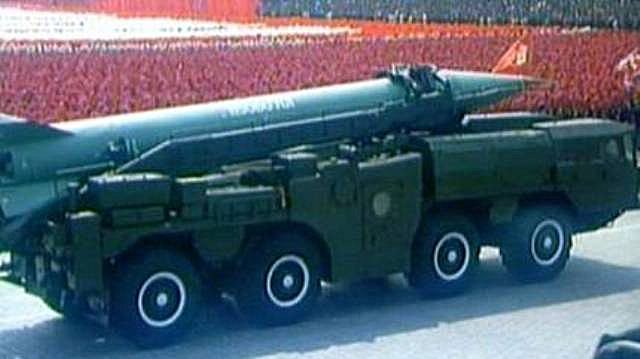
Given the facility's relatively small size and the timeframe it was constructed in (1980s), it's probable that it was built to provide a test site for North Korea's various SCUD missile iterations such as the Hwasong-5 or Soviet-sourced artillery rocket systems like the Luna family of short-range rockets (2K6 Luna, 9K52 Luna).
To support this idea, it should be noted that the concrete launch pad is aimed toward the East Sea and is angled along 52-53° which would allow even long-range missiles (depending on just how accurate the guidance is) to fly through the La Pérouse Strait, threading the needle between Japan's Hokkaido Island and Russia's Sakhalin Island, thus avoiding an international incident or risking populated places in the event of an accident.
Although I suspect that the facility was built to test missiles and not as an operational missile base, it's worth noting that there is no public evidence of it ever being used for a missile test. Based on the database complied by the Nuclear Threat Initiative, nearby tests occurred instead at Kittaeryong Operational Missile Base and around Tongchan, but none have been noted in the vicinity of Nungwol-li during its lifetime.
Over time, Nungwol-li has become degraded. The launch pad is partially covered by eroded soil, and the road network is not as well maintained as it has been in the past. But the main buildings and courtyard have been maintained, and so the facility could still be used to test short-range missiles or even be used to deploy surface-to-ship antiship missiles to help defend this portion of the coast in the event of a conflict.
Nungwol-li is little known and doesn't appear to play a particularly active role in the country's missile program or its defenses, but it is yet another facility that we must nonetheless continue to monitor. Some missile and artillery facilities go dormant, others will have years go by in between tests, while others still end up being demolished. The fact Nungwol-li still exists is a sign that the KPA continues to consider the facility worth investing in.
I would like to thank my current Patreon supporters who help make AccessDPRK possible: Donald Pearce, David M., Dylan D., HG, Joe Bishop-Henchman, Joel Parish, John Pike, Jonathan J., Kbechs87, Russ Johnson, Squadfan, Timberwolf, Yong H, and 덕형이.