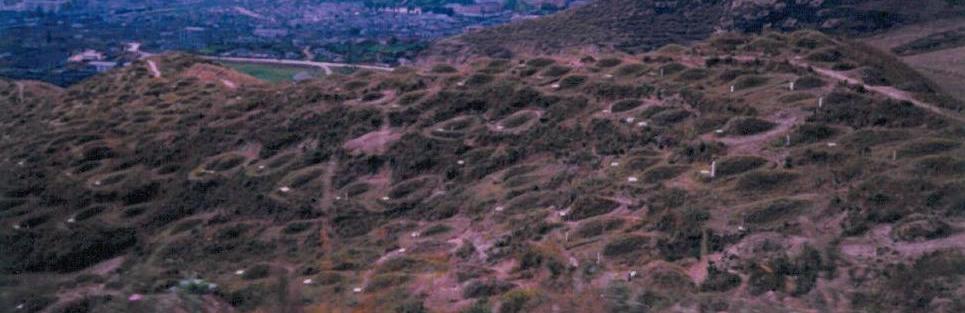
North Korea's hillsides host countless burial mounds in clusters ranging from just a few burials to many thousands.
These irregular cemeteries have been a common feature of mourning and remembrance for generations. But due to government orders in 2024 to help promote reforestation efforts, thousands of burials have been exhumed around the country and numerous mounds have been flattened by authorities.
This report reviews nine burial locations across five provinces and Pyongyang that help illustrate the extent of the policy's effect at present.

Uncredited image of traditional burial mounds on a hillside North Korea. Source: North Korea Economy Watch.
Hillsides have always been a preferred location for burials, and a casual glance at hills in both North and South Korea can reveal countless small mounds of the dead. But in North Korea, this practice took on a whole new importance during the 1994 famine that killed upwards of a million people as space in sanctioned burial grounds grew sparce and cremations remained unaffordable for many.
The famine itself was exacerbated by widespread deforestation caused by the need for firewood and in attempts to expand crop growing areas, but that only resulted in the topsoil being rapidly washed away, enabling floods to be stronger and causing crop yields to drop.
The resulting deaths and burials on the hillsides mean that on top of nearly every denuded hill near cities and villages are countless burial mounds. Some are dutifully tended to by living decedents and others have been forgotten as family lines die out, memories fade, and populations move.
The orders from Pyongyang allow for relatives to dig up and re-inter their loved ones, but for those graves that can't be emptied, local governments simply bulldoze them into oblivion.
This process can be seen across the country, from the starting point of tomb's being opened to the end result of the mounds being flattened and the land repurposed.
The first example I'll show is from a small hill on the outskirts of Pyongyang.

Numerous open tombs are visible; their remains having been exhumed.
On this hill in Pyongyang's Sadong District, you can see a mix of intact tombs and many others that have been opened (next to each yellow line). Although the government's orders to clear irregular cemeteries don't dictate what families must do with the remains, we can presume that they are either cremated or reburied at an approved cemetery.
Despite my searches, there are only limited examples of burial mound removals in Pyongyang. Perhaps I simply didn't look thoroughly enough or perhaps such a move - to demand the removal of burials of members of the country's elite families - would have been politically fraught.
The next example is at Chungsan.

Google Earth images of hillside burial removals in Chungsan, comparing the site in November 2019 and in June 2025.
In Nov. 2019 the town's burial mounds were all clearly visible and intact but by June 2025 a large swathe of them had been totally removed, and many others emptied. This site represents the largest clearance of burials in Chungsan.
A June 2024 story by DailyNK reported that authorities had intended on the cemeteries to be emptied by the end of 2024. However, while the process of exhumation has spread, most of these hillside cemeteries still remain at least partially intact.

Opened burial mounds in Songnim, 2025.
This hillside burial ground in Songnim is another representative of this clearance activity in a major city.
What isn't known is how long family members are given to enact the removals. Due to freezing winters, exhumations can only be carried out during certain times of the year, and they are most often done using manual labor.
Nor is it known how families are notified that a certain area is slated to be reforested or converted into farmland. Comprehensive, centralized records are not known to be kept of these sites, so if a family is unaware, can't be contacted, or can't reach the site quickly enough, it's probable that many burials become forcibly lost forever.

Bongsan burial mound removals.
In this example at Bongsan, east of Sariwon, you can see dozens of mounds were levelled at some point between 2022 and 2026, but quite a few still appear intact.
Other small burial grounds exist in Bongsan and all have had at least some of the mounds removed, but none have been completely razed.

Hillside burials in Chaeryong. A partial clearance of the mounds is visible.
This Chaeryong burial ground shows a mix of intact tombs, emptied ones, and shows an area on the eastern flank of the hill that has been cleared entirely.
North Koreans maintain traditional beliefs when it comes to death practices and consider family burial grounds to be sacred sites that should be honored.
Throughout the year family members will check on the grave sites and clear them of debris, and there are specific holiday observances, such as Chongmyong on April 5.
During Chongmyong, families visit the graves of their ancestors, make offerings, and share in their remembrances. In atheistic North Korea, this is one of the few traditional events that still carries spiritual weight and is widely practiced.
However, the burial clearances have begun to destroy those ancestral ties and diminish the ancient rites.

Before and after of tomb removals in Sampo-dong.
At this single burial ground in Sampo-dong at least 160 graves have been removed between 2022 and 2025. Several hundred others have been removed in the immediate area.
Although one of the driving forces for removing these burial mounds is ostensibly to help reforest the nation's hills, low hills such as these are often cleared to expand farmland. And while gaining farmland is obviously a national need, one has to question if the price of a few extra hectares is worth the destruction of local sites of multi-generational remembrance?

Former burial ground in Munchon, Kangwon Province.
One of the more curious outcomes of the clearance process can be seen in Munchon.
After graves were emptied and the mounds removed, the area has seen deep cuts into the ground. There is a small site used as a quarry at the foot of the hill, so one wonders if what we were seeing at this site is the expansion of quarrying activity to now include the former burial ground.

Illicit farm in Munchon being reforested between 2020-2026.
It should be noted, however, that reforestation efforts extend to more than just burial grounds, and have impacted illicit hilltop farms known as sotoji.
Further up the mountain from this burial ground, a ~1.3-hectare sotoji plot was planted over with trees in 2021-22.

Cleared burial grounds in Kumya, South Hamgyong Province.
The destruction of burial grounds around the town of Kumya is among the most widespread and striking.
Just within the area shown, some 250 graves have been completely destroyed. Another 500 or so burials in several other plots within half a kilometer of this site have also been removed.

Cleared burial ground in Hamju, South Hamgyong Province.
North, in Hamju, a further 200 burial mounds were removed.
Despite the public account of when the burial removal orders were issued, some large-scale removals were already underway in 2023, and so local pilot programs may have preceded the establishment of a national policy.
Most countries have regulations for burials. Where, when, what kind, are all questions that are not only important to the family but are also important for things like public health.
The proliferation of irregular burial grounds may have caused difficulty for North Korean authorities, especially on the local level, regarding things like land usage and trying to regulate the further erosion of hillsides.
However, forcing the great mass of the population to not only exhume ancestors but to then give up grave sites that have played an important role in the sense of family continuity that such places engender seems particularly harsh.
North Korea is already a place where family fealty must take a backseat to the state, and where even love for one's parents is supposed to be less than one's love for the Great Leader. Eliminating scores of burial grounds that have long served as communal focus points comes across as yet another attempt to further limit any sense of identity that may exist outside of the state.
I would like to thank my current Patreon supporters who help make AccessDPRK possible: Donald Pearce, David M., Dylan D., HG, Joe Bishop-Henchman, Joel Parish, John Pike, Jonathan J., Kbechs87, Russ Johnson, Squadfan, Timberwolf, Yong H, and 덕형이.
--Jacob Bogle, July 23, 2026