Monday, July 24, 2023

Kim Jong Un's Underground Pyongyang

Verifying the existence of underground facilities can be a difficult task, especially when their existence is a state secret. But rumors eventually come out and tantalizing hints of their presence can sometimes be found.

For North Korea, these rumors tell of secret subway lines beneath Pyongyang and underground highways connecting major palaces, maybe even reaching as far north as the border with China. I have written quite a lot about North Korea's underground infrastructure, but direct evidence and declassified sources still remain scarce. 

Overview of the Pyongyang Government District.

However, within the secured government district of Pyongyang are signs of multiple tunnels and underground structures. While it's impossible to know how they all connect to one another or even if they do, their locations and prevalence do hint at a fairly robust underground network that supports the infrastructure, transportation, and security needs of Pyongyang's most important district.

The easiest way to identify underground facilities is to either spot their entrances or actually catch them being constructed. For the secured government district, most of the buildings were constructed decades ago, placing their secrets out of reach for those without security clearances. But under Kim Jong Un, there have been some substantial changes to the district and that has given North Korea watchers an opportunity to see observe some of them.

There are two main sets of tunnels within the 138-hectare district that are visible to satellite. The first is a set of four tunnels near the Central Committee Office building (also known as Kim Jong Un's office) and the adjacent villa (Residence No. 15). The second is a set of four tunnels leading to underground parking garages beneath three buildings that were constructed in 2018-2019.  

There is also a possible tunnel, marked in light blue, but I can't fully verify that it is a tunnel. In some images, however, it appears that there may be a road tunnel that dives under a gate near Kim Kyong-hui Hall, just south of Changgwangsan House.

But the tunnels around Kim Jong Un's office and Residence No. 15 are quite clear.

April 10, 2020 image of the four tunnels around the Central Committee Building (Kim's office) and his district villa, Residence No. 15.

Apart from the tunnels by the villa and office, which I'll detail next, there is also a smaller tunnel in the maintenance complex. This complex handles building heating and cooling equipment, provides maintenance services, and may also play a role in electricity and water supply to the adjacent buildings. The tunnel (39.016557° 125.743544°) is 5-6 meters wide and runs toward the southwest. It's visible on all satellite imagery going back to 2000.

The tunnel may simply lead to a hardened bunker housing additional equipment or it could actually connect into the Office 39 complex (which includes the Kim Il Sung Revolutionary History Institute [39.016134° 125.741890°] and other Party buildings). Given its size and location, I do not think this tunnel plays any special security role. Rather, it's most likely just an access tunnel for providing building services.


April 1, 2023 image showing changes since 2020.

In 2022 a villa was rebuilt and enlarged, and in late 2022 a new hardened structure was built over the site of the tunnel nearest Kim's office building. 

The 'office tunnel' is large enough for vehicles and may lead to an underground garage or a larger underground complex. The hardened structure above it is approximately 60 by 30 meters in size and rises approximately 3 meters above the surrounding gardens.

Conjectured tunnel layout.

Due to the number of visible entrances, a concept of the tunnel layout can be formed with some confidence despite not having all the information. 

The covered walkway from Residence No. 15 was constructed in 2010. It resembles another such walkway that was built in 2017 in the armed forces district 5 km north at 39.062677° 125.740196°. 

The southern tunnel entrance was also constructed ca. 2010-11. Following the path drawn in the above image, the southern tunnel is about ~150 meters from the northern tunnel at the Central Committee Office Building (CCOB). 

The northern tunnel, however, was only constructed in 2018. This means that the southern tunnel likely went directly to the CCOB, where an alleged 60-car garage also exists beneath the assembly hall. 
This connection allows people from Residence No. 15 to travel on foot or by car directly and safely to the CCOB. Then, in 2018, a new tunnel was built from the CCOB that would link up with the southern tunnel.

This construction also included the building of an underground structure which was later (2022) replaced by the 60 x 30-meter hardened structure now seen in satellite images. Allegedly, a small, electrified rail car is also employed within the tunnels, but I haven't seen any supporting evidence of that.

To the north of the Central Committee Office Building, between 2018 and 2020 four currently unidentified buildings were constructed. These buildings include glass-covered entrances to underground parking garages that, most likely, would also double as bomb shelters in the event of an air attack.

Underground garage entrances under construction in June 2020.

The underground garage entrances after completion are covered by glass canopies.


There are also reports (including from Hwang Jang-yop) that the Pyongyang Metro has a secret line for government use that connects important government and military installations around the capital, and that it even reaches as far as Nampo and Sunchon (50 km away). While this has never been independently verified, the government district does lie within 2 km of four subway stations, with the closest being Pongwa Station at only 600 meters away from Kim's office.

As most of the district was constructed in the 1960s and 1970s (as was the metro), underground entrances to the metro system could be hidden beneath key administrative buildings, beyond the prying eye of today's satellite fleet. I have doubts about a sprawling network of transportation tunnels connecting far flung facilities, but a local network connecting underground command centers and emergency escape routes is quite plausible. 

Location of other known tunnels and underground facilities (UGF).

Whether underground sites exist in isolation or connect to larger tunnel networks beneath the government district and beyond, the sheer number of bomb shelters and other underground facilities alleged to exist makes the possibility of a successful "decapitation strike" by South Korea or the United States far more difficult and less likely to be effective, as such an attack relies on knowing where the target individuals are and killing them before they have time to escape to another location.

While I can't comment as to the quality of their construction, as a regime hyper-focused on survivability, North Korea probably has the greatest density of underground facilities and secret tunnels of any country on earth. 


I would like to thank my current Patreon supporters who help make all of this possible: Alex Kleinman, Amanda Oh, Donald Pierce, Dylan D, Joe Bishop-Henchman, Jonathan J, Joel Parish, John Pike, JuneBug, Kbechs87, Nate Odenkirk, Russ Johnson, and Squadfan.

--Jacob Bogle, July 24, 2023

Tuesday, June 20, 2023

Bye, Bye Airports

Ever since Kim Jong Un came to power, North Korea's aviation infrastructure has undergone a series of changes, making it difficult to keep an up-to-date record of what airports and landing strips exist and where.

For this article, I want to review more recent changes and provide an update to the last AccessDPRK post that focused on the country's air force back in 2018.

KCNA photograph of Kim Jong Un inspecting aircraft at Kalma International Airport. 

Starting in 2014 Kim constructed several small new runways at his favorite palaces, then he went about improving the country's emergency landing strips. Before that, he oversaw the modernization of Pyongyang International Airport and then majorly expanded the Kalma Airport in Wonsan.

In recent years, however, the trend has reversed. Eight airports have been razed and another converted to other uses (at least for the time being).


Before and after of the Sinchon Palace runway (38.350777° 125.535155°).

Two of the palace runways were removed and replaced with horse riding tracks - Sinchon Palace Runway (built in 2015, replaced in 2019) and Wonsan Palace Runway (built in 2014, replaced in 2019). These horse riding tracks are for Kim Jong Un and his closest allies to use, but a number of recreational and military horse tracks have also been established elsewhere around the country. 

Before and after of the Wonsan Palace runway (39.184090° 127.397012°).

A third palace runway, at Myohyangsan (40.028515° 126.193115°), was demolished in 2021.


The Pyongyang VIP Heliport (39.049587° 125.805278°), built in 2015, is also now being removed and a new complex of buildings is being constructed in its place. The full purpose of the building complex isn't yet known.


Ariel photograph of the Jungphyong (Kyongsong) Vegetable Farm. Image: Rodong Sinmun, 2019.

Then there are the two airbases that have been demolished and replaced with large vegetable farms and greenhouses - Kyongsong Airbase (41.558215° 129.629752°) was demolished in 2018 and the Yonpo Airbase (39.790289° 127.535685°) was demolished in 2022. This has been the largest transfer of military property to the civilian sector that I am aware of, affecting slightly over 5 sq. km. 

Although the Kyongsong Airbase was demolished for the vegetable farm (named Jungphyong after a nearby village), the associated air force officer training school still exists (41.577780° 129.634636°). 


Overview of the Uiju Decontamination Facility (40.152699° 124.499932°).

COVID-19 has also impacted the availability of airbases to the North Korean air force. The Uiju Airbase, near Sinuiju on the border with China, was shut down in 2021 and some of its aircraft transferred to other sites. Then Uiju was fenced off and turned into a massive decontamination facility for goods coming into the country from China. 

Unlike Kyongsong and Yonpo, the runway and other facilities at Uiju still remain and it could be reconverted into an active airbase at any time. 


Kumgang, a county in Kangwon Province and where the Mount Kumgang Tourist Region is located, only had a small dirt runway that was routinely damaged by floods. In 2011-2012, to the north of town, a new kilometer-long paved runway was constructed, complete with aircraft parking revetments, service buildings, fuel storage, and hardened bunkers. It also goes by the name of Onjongdong-ni Airfield. 

Yet, in the imagery available, there's no clear evidence that the runway was ever used and the runway itself deteriorated over the years due to flooding. In 2021 several of the bunkers were demolished and the above-ground fuel tanks were removed. However, the runway's fate had already been sealed much earlier.

In 2018 the construction of a dam 1.7 km to the south began. The runway will eventually be covered by the reservoir once the dam's completed.  


Last of the removals, the small Kangdong Airbase (39.158318° 126.039708°) was demolished in 2019/2020 after being remodeled in 2015. It was home to KPAF Unit 2620, an all-female pilot unit. 


Sunchon Airbase underwent a recent expansion program.

In the midst of all of these removals, the Sunchon Airbase underwent an expansion beginning in 2021 and ending in 2023. The Center for Strategic and International Studies has tracked the progress of this project in detail (Part I, Part II, Part III), but it involved the addition of a 300-meter runway extension, the construction of 16 aircraft shelters, a new hardstand with space for 15 aircraft, and all surfaces have been repaved. 


With all of these changes, I think a current round-up of North Korea's aviation infrastructure is in order.

Excluding the now former airbases, there are 128 identified airports, landing strips, helipads, emergency runways, and UAV facilities. 

There are six primary airbases, 26 additional airbases with paved runways, 22 basic airfields (including grass landing strips), 30 emergency highway runways, 35 helicopter facilities, and seven UAV sites (which is a topic for another article). I also have the locations of 18 former and disused runways. That figure may change in the future as additional sites are discovered (such as demolished runways that existed during the Japanese occupation or Korean War).

With the exception of Uiju, no major airbases or runways have been affected by these changes. Practically speaking, only redundant airfields were demolished and whether or not Kim Jong Un has an on-site palace runway for his personal use makes little difference to the military.


I would like to thank my current Patreon supporters who help make all of this possible: Alex Kleinman, Amanda Oh, Donald Pierce, Dylan D, Jonathan J, Joel Parish, John Pike, JuneBug, Kbechs87, Russ Johnson, and Squadfan.

--Jacob Bogle, 6/19/2023

Friday, May 19, 2023

Tee-up, North Korea's Golf Courses

Pyongyang Golf Club in 2015, prior to expansion program. (CC BY-SA 2.0, Uri Tours)

It is often erroneously reported that North Korea only has a single golf course. In fact, the country has three, but none are open to the general public. In this article, I'll examine each one and their current status.

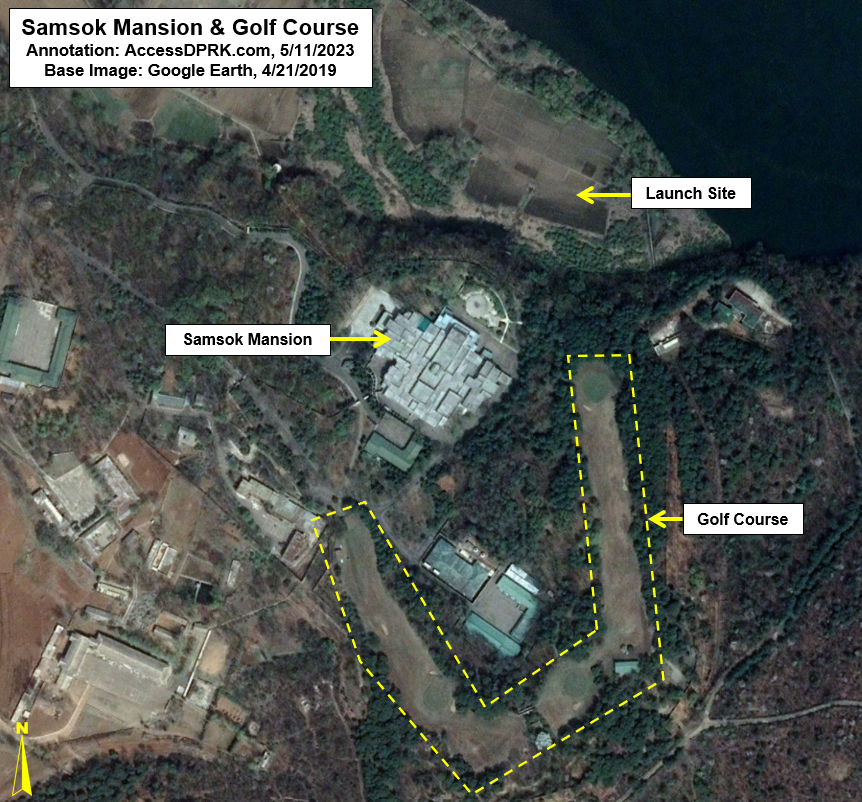
The golf course (39.107805° 125.997879°) at the unofficially-named Samsok Mansion, along the banks of the Taedong River east of Pyongyang, was recently in the news because North Korea tested its Hwasong-18 intercontinental ballistic missile on April 13 from a launch pad mere meters away. 

The launch site is located on an island within the mansion complex that was fitted out with berms and ponds (for an unknown reason) prior to the missile test. 

The golf course is the nation's smallest and was added to the mansion grounds in 1986. It consists of three holes with six sand traps which are arranged along a semicircular course running for 600 meters.

The mansion isn't one of the main residences for the Kim family, but it is surrounded by a dozen smaller villas set within a wooded landscape that are all interconnected by a network of private lanes. This suggests that the mansion serves as the center of a rural 'getaway' for the country's elite and provides a slower pace of life for those visiting.


Pyongyang Golf Club after 2017-2019 renovations.

The most well-known golf course, however, is the Pyongyang Golf Club (38.897281° 125.437426°). Located on the banks of Lake Taesong, this 18-hole course is part of a larger 16.4 sq. km. pleasure ground for the country's elite. Opened in 1987, it has been reserved for use by the country's wealthy and foreigners. 

In 2011 it began hosting the DPRK Amateur Golf Open, but there hasn't been a new tournament since 2016 despite attempts by several tourist groups to resume the competition.

Pyongyang Golf Club after most new construction had been completed in 2019.

However, that doesn't mean activities at the golf course have ceased. In 2018 plans were released by the government detailing an expansion of the Club. This included the addition of nine new holes, additional lodgings and other facilities.

Construction actually started as early as April 2017, with early landfill activities, but it began in earnest in 2018 and by February 2019 at least 13 buildings were nearing completion. Changes at the site also involved the creation of a small pond (by building a barrier to enclose a smaller portion of the lake) and the installation of a helipad which was finished by Nov. 2019.

Close-range ballistic missiles being launched on March 10, 2023 at Taesong Lake. Image: KCNA

Approximately 1 km north of the original club house is a peninsula that was meant to hold five of the nine new golf holes. Those have yet to be constructed but the peninsula did serve as the site of CRBM missile launches in March 2023. 


North Korea's third golf course was created as part of the Mount Kumgang Tourist Region (38.712675° 128.213664°) beginning in 2005. The course and grounds cover approximately 143 hectares and contains several lodgings/hotels, a clubhouse, and access to the floating Hotel Haegumgang.

The tourist region had been established as a joint DPRK-ROK venture, but the effort didn't last long.

The golf course in 2021 after years of neglect. 

Following the killing of a South Korean tourist in 2008, tourism from South Korea was halted. The North Korean government began to run domestic tours to the region in 2010 but these tours didn't generate much interest. 

For all intents and purposes, the golf course was shuttered soon after. Both sides have floated ideas to restart joint tourism, but nothing has come of these talks. 

In 2019 Kim Jong Un announced his intentions to rebuild and modernize the golf course and the whole tourist zone (regardless of South Korea's desires, as the area was largely financed by South Korea). This included the demolition of a hotel next to the golf course, the planned destruction of the Hotel Haegumgang, and other sites throughout the 530 sq. km. region.

As of late 2022, no new construction is visible, and the golf course has been allowed to decay. 


The former Yanggakdo Golf Course as seen in May 2011, a few months before its removal.

There had been a fourth golf course (38.997397° 125.750226°), one that was located on Yanggakdo Island in the middle of Pyongyang, next to the famous (or infamous) Yanggakdo International Hotel. But it was removed in late 2011 to make room for another hotel; however, that hotel still hasn't been completed.


I would like to thank my current Patreon supporters who help make all of this possible: Alex Kleinman, Amanda Oh, Donald Pierce, Dylan D, GreatPoppo, Jonathan J, Joel Parish, John Pike, JuneBug, Kbechs87, Russ Johnson, and Squadfan.

--Jacob Bogle, 5/18/2023