Tuesday, October 15, 2019

Air Defense and Combat Command HQ


Situated in the town of Chunghwa, south of Pyongyang, North Korea's air force headquarters is located at the "Air Defense and Combat Command" (from here on abbreviated KPAF HQ). From here, over 110,000 personnel, 1,700 aircraft, and 37 key bases (along with less important ones) are overseen by a headquarter complex that is nestled within a range of low hills.

Little is directly known about the complex, but based on Landsat/Copernicus satellite imagery, we can determine that the headquarters has been in this location since at least 1984. Unfortunately, the image resolution is very low but you can still make out lighter colored man-made structures against the darker, tree-covered hills.


North Korea's air force, the Korean People's Air Force (KPAF) is divided into six primary combat, training, and transport divisions.

  • 1st Air Combat Division (headquartered at Kaechon)
  • 2nd Air Combat Division (headquartered at Toksan)
  • 3rd Air Combat Division (headquartered at Hwangju and is responsible for the DMZ)
  • 5th Air Transport Division (headquartered at Taechon)
  • 6th Air Transport Division (headquartered at Sondok)
  • 8th Air Training Division (headquartered at Orang/Hoemun-ri, is also responsible for the defense of the northeastern part of the country)

Within the divisions include associated forces like airborne (which has at least seven training bases) and reconnaissance. The KPAF has also had a drone (UAV) program since the 1970s.
The use of drones continues to be of concern to South Korean and Allied forces, particularly after multiple sightings of North Korean UAVs and incursions into the DMZ and ROK airspace. Small UAVs flying at under 500 feet are capable of avoiding most radar and air defense systems, leaving South Korea vulnerable to the asymmetric capabilities that UAVs bring to the battlespace.

The first clear look at KPAF HQ comes from imagery dated November 2006. (Click on any image for a larger view.)


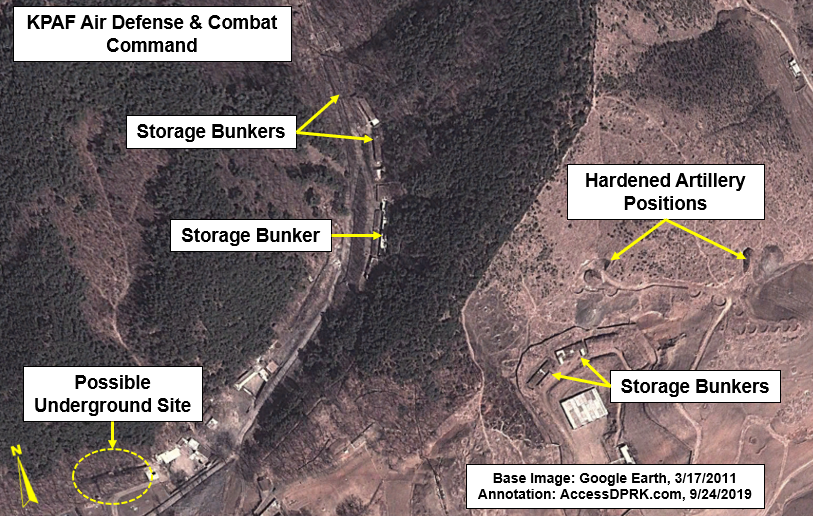
The eastern quadrant of the base holds storage bunkers and a possible underground entrance. There is also an old hardened artillery site just outside of the base's perimeter.

Between 2012 and 2013 a new building was constructed next to the Juche Study Hall. It's likely a gymnasium due to the recreational sports fields next to it. A crisp image of the building can be seen on October 26, 2015.


Since 2006, thirteen buildings have been constructed within the complex.


Construction of the newest buildings began in 2017. They lie at the rear of the base (due north), and include three, three-story residential buildings, a possible new assembly building, and another large building with an unidentified purpose. These buildings are in the same area as an underground entrance which itself saw construction work in 2011.


The underground site could be part of building an underground command center but there's no real way to know what the current purpose of it is or its status.

The regime has been placing a lot of effort into modernizing its conventional forces as well as its nuclear program. Today's KPAF HQ is a much different place than it was in 2006, with most of the changes happening under Kim Jong Un.


Despite having a dated air fleet, Pyongyang is creating indigenous air defense systems, they are working on ways to avoid sanctions on fuel, and they are trying to computerize as much as possible. This means that a modern headquarters is needed to oversee an adequate defense structure while also maintaining their abilities to carry out offensive war plans should they determine the time has come.


I want to give a quick shout out to my Patreon supporters: Kbechs87, GreatPoppo, and Planefag.

--Jacob Bogle, 10/14/2019
Patreon.com/accessdprk
www.JacobBogle.com
Facebook.com/JacobBogle
Twitter.com/JacobBogle

Wednesday, October 2, 2019

Missiles and Monuments

North Korea has been touting itself as a strong, powerful, socialist nation for generations. That propaganda, however, has largely been devoid of reality. That is, until the newest incarnation of the divine Paektu Bloodline arrived to save the people of North Korea. Whatever caricatures may exist of Kim Jong Un being a squat, little "rocket man" with funny hair and whatever very real criticisms exist of the terrible human rights situation in the country, the fact is undeniable: Kim Jong Un has fulfilled the nation's long promoted promise of turning North Korea into a nuclear-armed state with a credible missile deterrent.

While the country has had a missile program for decades, the main propaganda surrounding those developments were limited to posters, songs, and "documentaries", even when progress was made under Kim Il Sung and Kim Jong Il. However, satellite imagery shows that Kim Jong Un feels he deserves something more long lasting, something written in....stone.

Kim Jong Un has tested more ballistic missiles than both of his predecessors combined, and key milestone launches have now been commemorated with monuments of stone. These monuments center on launches carried out in 2017, North Korea's "miracle year" in which they tested missiles capable of hitting all parts of the United States and tested their largest nuclear bomb to-date.

There are five of these launch commemorations known, with the latest one being under construction as of May 2019. The fact the regime is still building these monuments may contradict their claims to have accomplished a nuclear deterrent (at least to their satisfaction) and contradict occasional claims that the government will begin to move away from the "two track" system (developing the economy and nuclear weapons in tandem) to focus on the economy, as it shows Pyongyang is still placing a new level of emphasis on these weapons. (Not to mention all of the other worrying signs that North Korea has no intention to denuclearize.)

I want to give a quick shout out to Joseph Bermudez and Victor ChaJeffery Lewis, and Dave Schmerler for their respective work on individual monuments.


1. Missile tested: Pukkuksong-2. Date: Feb. 12, 2017. Location: Iha-ri driver and vehicle test facility,  40° 0'47.38"N 125°13'22.21"E.


The dimensions of the monument space is roughly 24 m x 19 meter, while the monument itself is a small stone about 2.5-3 meters.

The location of the monument is actually ~320 meters away from the launch site. The test stand that was used was one of the sites demolished in hopes of helping relations between North Korea and the United States.


2. Missile tested: Hwasong-12. Date: May 14, 2017. Location: Kusong, No. 112 Factory, 40° 3'56.61"N 125°12'34.45"E.


The monument foundation first appeared in October 2018. The fact it hasn't been completed by now suggests the work has been suspended for some reason. The concrete pad is approximately 27 meters long. The wider section (left-side) is 10.5 meters wide and the thinner, longer section is about 8 meters wide. Some of the commemorative monuments incorporate the launching pad itself into the overall monument site, so the thinner, longer section could be it.


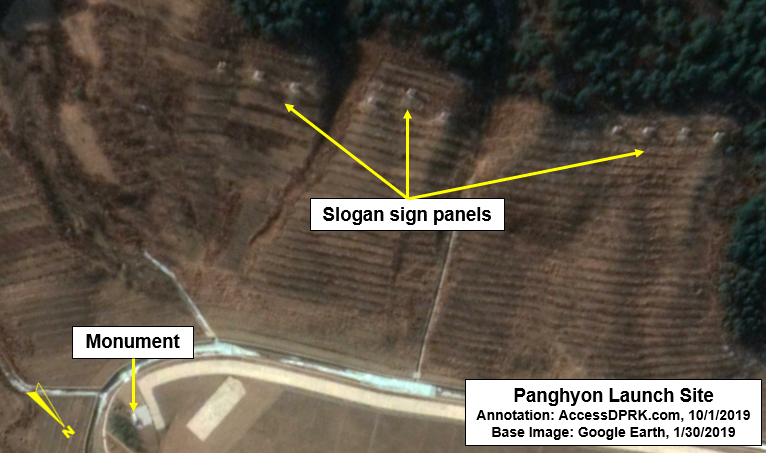
3. Missile tested: Hwasong-14. Date: July 4, 2017. Location: Panghyon Aircraft Factory, 39°52'19.48"N 125°16'10.85"E.


The test happened within the grounds of the Panghyon Aircraft Factory, some 6.5 km southeast of the Panghyon Air Base. Kim Jong Un called the test a "gift to the American bastards" on America's Independence Day.

A second monument was constructed at the observation post located a kilometer away, but it was later demolished. Currently, this is the only stone monument at the site. Across from the monument, up the hillside, is a slogan sign that was also erected after the test. Unfortunately, the image isn't of sufficient quality to know what the sign says.


4. Missile tested: Hwasong-14. Date: July 28, 2017. Location: Mupyong-ni, No. 65 Factory,  40°36'39.56"N 126°25'32.92"E


The location of this launch may be referred to as Mupyong-ni, which is the name of the local village, Jonchon, which is the name of the city this is in, or Factory No. 65, which is the name of the missile factory the launch actually took place in.


5. Missile tested: Hwasong-15. Date: Nov. 28, 2017. Location: Near Pyongsong, 39°18'58.25"N 125°52'58.08"E.

The Hwasong-15 missile is North Korea's longest-range missile that has been tested. It is theoretically capable of hitting nearly all of the US mainland. Not surprisingly, the monument to the launch is the largest of the five.


Including green space, the monument's area is 75 x 61 meters. The launch site occurred 4 km north of the March 16 Factory in Pyongsong. The factory produces a wide array of military vehicles and supports the missile program by either manufacturing or modifying launch vehicles. According to 38 North, "it was revealed that the building and temporary shelter were used to modify the Hwasong-15 TEL and test the operation of its elevation cradle and detachable launch table for the November 28, 2017 test launch."


One thing that I have found interesting is the variety of locations where North Korea has tested missiles. Factories, fields, vehicle test ranges, beaches, air ports, and even places that are actually dedicated to missile launches like at Hodo. These tests are not only to show that the country has the needed capabilities to successfully launch them, but the range of testing locations is a none-to-subtle message to the world that they are able to do so from any part of the country, not just from military bases or sites with purpose-built infrastructure.


I would like to thank my current Patreon supporters: Kbechs87, GreatPoppo, and Planefag.


--Jacob Bogle, 10/1/2019
Patreon.com/accessdprk
www.JacobBogle.com
Facebook.com/JacobBogle
Twitter.com/JacobBogle

Monday, September 16, 2019

The Great Songwon Mystery

I have a page of "mysteries" for the #AccessDPRK Mapping Project. They're sites that I either don't know what they are, can't firmly identify, or would like more specific information on (like different palaces). One of those sites is in North Pyongan Province and it has a tunnel, water running out of it, and an electrical substation. Obviously it's a hydroelectric plant, right?

The problem is that there isn't a dam or reservoir nearby, neither is there a gravity-pump setup. So where's the water coming from?


I sat with this little mystery for a few years because there was no obvious source of water. Could it be some secret underground facility and the "stream" coming out of it is just drainage? North Korea does have plenty of those, but then other aspects of the site didn't really make sense for it to be an underground military base or factory. So, as I said, I sat with the mystery.


I was recently researching some of the country's large dams and came to Songwon Dam in Chagang Province, about 42 km away from the first site. Every source that mentioned Songwon said that it was a hydroelectric dam. There's one problem with that. Songwon doesn't have a hydroelectric generator, not even one downriver like many other hydroelectric sites do. Now I'm sitting here with a hydroelectric dam with no generator in one province and an apparent generating site with no dam in another province.


The next step was finding out that the apparent mines in the area form a lovely 42km-long straight line from Songwon directly to the mystery site. In fact, they're not mines at all, but the excavated debris from one heck of a tunneling project - a tunnel that takes water from the Songwon reservoir and to the hydroelectric generating site. Thus, Songwon is a hydroelectric dam. It just makes its electricity in the neighboring province. Songwon was completed in 1987 and Landsat/Copernicus satellite imagery also shows construction work happening at the "mystery site" in 1987, too, further verifying their connection. A happy little mystery is now solved.


It seems like North Korea isn't done creating these huge tunnel systems. There's the newly finished Wonsan People's-Army Power Station in Kangwon Province. It, too, has a tunnel taking water from the reservoir to a generating station that, in this case, is 28 km away.

Having the generating site farther away from the dam means that you can get a greater change in elevation which will increase the water's speed as it moves downhill. The faster water moves the more momentum it has, and that means it can turn turbines faster, generating more electricity. If a dam is 200 feet above sea level, you'll get a lot more electricity generated if you have the generating station at 30 feet above sea level vs. at 150 feet by making that water drop 170 feet instead of just 50.

The Wonsan dam is at 1,800 feet and the first generating station (there's two) is at about 680 feet, a massive drop. However, they could have achieved the same amount of elevation drop using a tunnel 10 km shorter if they went toward a different direction. The same is true of Songwon. From the intake site to the generating station there's a ~560 foot drop...spread out over 42 km! In the case of Songwon, that elevation drop could have been accomplished by placing the generating station 25 km downriver.
However, the tunnel would not have been able to be in a straight line, making construction more difficult. It appears that the Wonsan tunnel could have been in a straight line to reach the shorter distance, so I don't know why they opted for the longer journey instead.


The next image is a picture of an intake tower with a similar layout as the one at Songwon. The "window" on the tower is to let air in to prevent a vacuum from forming and damaging the system.

Water intake tower at the old Desna Dam, Czechia. Source: Wikimedia.

The last thing I'll say about Songwon is that even though the reservoir is massive (it covers 18.3 square km and has a capacity of 3.2 billion cubic feet of water according to the FAO), the amount of water coming out of the generating station is very small. The size of the electrical substation is also rather tiny compared to the ones at other large dams. This is because the water intake point is actually at the surface level of the reservoir. If the reservoir is even slightly low, water wont flow into the tunnel to turn the generator. This means that despite the enormous effort North Korea put into constructing everything, it doesn't seem to be generating much electricity in return. Of course, North Korea isn't exactly known for their efficiencies - be it efficiencies in design, labor, or cost, the regime really seems to like expending huge effort for little gain.

I want to give a quick shout out to my Patreon supporters: Kbechs87, GreatPoppo, and Planefag.


--Jacob Bogle 9/15/2019
Patreon.com/accessdprk
www.JacobBogle.com
Facebook.com/JacobBogle
Twitter.com/JacobBogle