Saturday, August 3, 2019

Radioactive River

(The second part of this article can be found here "A Pyongsan Addendum")

North Korea is a signatory to the Paris Accords, has made plans to reforest the country, and uses propaganda to show off how clean and beautiful the country is. While it is true that the North Korean countryside can be lovely and that there are densely forested mountains, North Korea is also an impoverished industrial country with a fascination with nuclear weapons. In such regimes, industrial and military progress always takes precedent over nature and the well-being of people. One such example of this is the Ryesong River, which is heavily polluted with waste material from the Pyongsan uranium mine and concentration plant.


One of North Korea's two known uranium processing plants, Pyongsan lies at the confluence of two rivers, the largest being Ryesong, which flows south for approx. 80 km, through the city of Kumchon and into the Han River estuary, which is shared by both Koreas, before emptying into the Yellow Sea.

The plant concentrates uranium from coal which is mined north of the plant. Uranium can be mined out of natural ores containing higher levels of the radioactive element or it can be found in lower quality coal - which North Korea has in abundance. Getting uranium from the coal involves a lot of steps and results in literally tons of toxic water and sludge being produced.
Normal international precautions for dealing with toxic materials include limiting the amount of polluted exhaust and aerosols, treating waste water, and storing waste materials in reservoirs that are lined with multiple layers of thick sheeting to prevent the contamination of ground water.


North Korea began constructing these uranium milling facilities in the 1980s. While there's only satellite evidence of leakage dating to 2003, it is highly likely that this has been ongoing for decades. The facility itself sits near the confluence of a smaller tributary river the larger Ryesong River, meaning that anything dumped into the tributary will quickly enter the Ryesong.

For additional detail about the plant itself, check out 38North's article.

Thanks to Google Earth, we can identify (unfortunately) that the pipe taking waste materials to the open reservoir has leaks and has been spilling toxic water into the Ryesong's tributary, which is then carried downriver until it finally empties into the Han River estuary and adds to the contamination of the Yellow Sea.
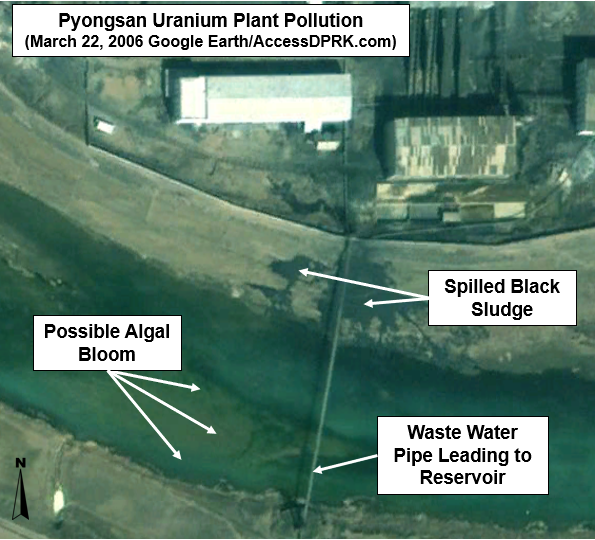

In this image from 2006, a clearly identifiable layer of black sludge has accumulated beneath the waste pipe as it leaves the factory. An apparent algal bloom is also visible. Small blooms naturally happen all over the world, but they can also be the result of certain kinds of pollution. The blooms release toxins of their own and can be very harmful to fish and people.
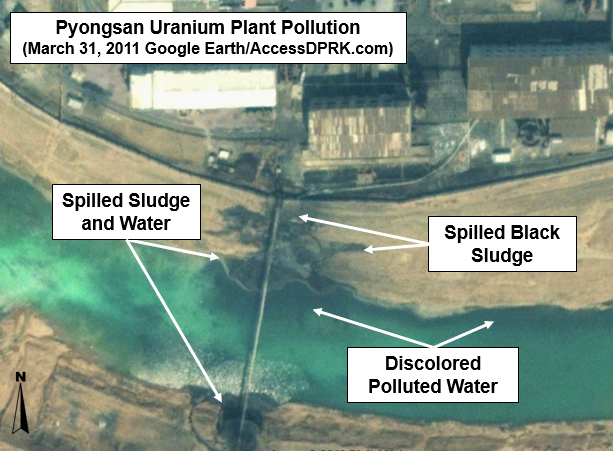

Fast forward to 2011 and you can see that the sludge has actually piled up on the riverbed, that it is coming from both ends of the pipe, and that the polluted water is flowing downstream as it hugs the north bank of the river heading to Ryesong.


In May 2017, a leak of an unidentified white-colored material can be spotted. Like the leak from 2011, this lighter material can clearly be seen being carried downstream.


The continual spilling of material can also be clearly seen during winter. The otherwise frozen tributary river is melted at each end of the pipe, where hot waste water is being dumped directly into the river.


The waste water reservoir occupies 338,000 square meters (33.7 hectares) and doesn't appear to be lined at all. This places any groundwater and wells at great risk as well as offers more opportunities for toxic materials to seep into the river.
Around 200,000 people live near the factory and downstream along the Ryesong River. Aside from the two main cities of Pyongsan and Kumchon, there are multiple small villages that line the riverbanks. The river is the only above-ground source of water for drinking, washing, and farming. Plants grown using polluted water often concentrate those pollutants and those are then passed on to the animals and people that eat them.
The various pollutants from the factory are then added to the other runoff received by the Yellow Sea, which is home to roughly 600 million people.

River pollution is a major problem in North Korea and even affects Pyongyang's main source of drinking water.


--Jacob Bogle, 8/3/2019
www.JacobBogle.com
Facebook.com/JacobBogle
Twitter.com/JacobBogle

Thursday, June 13, 2019

Being Gay in North Korea

(Image source: Equaldex)

Like many authoritarian regimes around the world, North Korea doesn’t recognize even the existence of LGBT people. In 2014, state media declared, "This practice can never be found in the DPRK boasting of the sound mentality and good morals..." Likewise, Chechnya and many central African and Asian states claim that homosexuality is a moral aberration brought about by capitalism or as a remnant of decadent imperialism. Of course, reality is rather different. There is no debate that homosexuality has existed in all parts of the world for all of human history. It is just as normal as any other form of humanity, be it blue eyes, dark skin, or being right-handed.

While former colonial nations take great pains to erase obvious signs of their national subjugation, many of those now independent countries opt to keep their anti-LGBT laws on the books and go to great lengths to defend them, despite the bad intentions behind the original implementation of those laws. Various colonial laws, from India to Kenya, remain on the books and many of these laws were put in place to suppress indigenous cultures and religions, and to force the inhabitants to behave the way their morally superior overlords demanded. Unfortunately, 70 countries still outlaw same-sex relationships, with many threatening extended jail times or even death. But what happens when a country doesn’t even recognize the existence of those with same-sex attraction?

The North Korean government has spent decades trying to reverse the effects of the Japanese occupation, trying to show the deficiencies of former Korean kingdoms, and attempting to strike a balance between socialist ethics and Confucian morality. North Korean propaganda would tell us that the country is a socialist paradise, free from all of the impurities of capitalism, class division, and imperialism. Among those impurities, of course, is not just homosexuality, but free democratic processes, the ability to decide what to do with your own life, and the right to dissent. There are no known laws specifically aimed at homosexuals, but there are laws pertaining to the security and unity of the state and society. The government’s outlook on LGBT people is likely similar to their outlook on religion. You’re free to believe what you want, so long as it doesn’t threaten or question the supremacy of the state in any way. In practice, this means there is no religion and those caught sharing religious ideas, or even ancient mysticism, can be executed.

Like religion, homosexuality brings up "dangerous" questions surrounding individuality. North Korea prides itself on unitary thought and actions. The Mass Games are a key piece of that propaganda for it demonstrates the unity of spirit that socialism brings by showing 100,000 people putting on a show. Threatening unity threatens the very existence of the state, and little else highlights the beautiful diversity of humanity than a group of people that not only don’t conform to traditional sexual roles but can also bend gender lines to the point that, for many, such artificial social constructs no longer exist. So, while a specific law may not exist, the appearance of threatening society is itself a crime.

There are no international gay travel groups that visit Wonsan’s white beaches and there are no known gay clubs in Pyongyang (at least, none that openly operate). But gay North Koreans exist surely as right-handed North Koreans do. Various estimates show that anywhere from 2 to 5 percent of a population will be gay or lesbian (the numbers tick up even higher when you include bisexuality). That means that statistically there are between 500,000 and 1,250,000 LGBT North Koreans.

Very little direct information from inside the country has reached the western world regarding matters of sex and sexuality. And, out of over 100,000 known defectors, only one, Jang Yeong-jin, is known to be openly gay. It would be fair to assume that the vast majority of LGBT people do not live open lives. North Korean’s general knowledge about sex and sexuality is primitive at best, with many women not even knowing what sex entails until the time comes. The rise of markets has helped in this regard, with rooms being rented out by the hour and young couples engaging in more open dating behaviors (like holding hands), but many North Koreans remain naïve. North Korea has many social anachronisms and is often described as a place lost in time.

Despite a clear history of homosexuality in ancient Rome, Greece, and China, the words “heterosexual” and “homosexual” weren’t even coined until 1869. This, plus what little information has leaked out of the country on the topic of homosexuality, leads me to believe that those million LGBT people probably couldn’t even describe themselves as gay or lesbian because they don't have the words. (Something Jang Yeong-jin has said as well.)
They know they have different desires and they know that living their lives being open with those desires would be dangerous. Undoubtedly, most end up marrying members of the opposite sex and do the things expected of them by family and society, as we know countless others do around the world.

In certain situations, like within military and university settings, same-sex behaviors appear to be an open secret. Older officers or students will take a younger man for his lover until such time as they get married to an approved female spouse. Whatever emotional relationships formed will either come to an end or are forced to be transformed into a platonic friendship or professional relationship. Even in cases where this is only "situational sexuality", where the participants aren't gay but engage in same-sex sex when women aren't available or when celibacy is required, the consensual behavior itself can get you into trouble as it is viewed as part of anti-socialist moral weakness and a threat to the state.

"Jang says he could cope with limited food or clothing in North Korea but having nothing to dream for left him miserable." - CNN

Socialist governments pride themselves on “granting” equality for women, agency for children, and being the voice of the oppressed, but when it comes to sexuality, they are often more illiberal than conservative capitalist states. Though the decriminalization of same-sex activity became de facto legal within Soviet Russia due to the abrogation of the Tsarist legal code, other soviet republics who never had such laws before (like Abkhazia, Georgia, and Turkman) ended up making it illegal. Among all communist countries, this push back against minorities of all kind, sexual and ethnic, was greatly increased during the Stalinist era. North Korea was no exception. The DPRK is both a highly homophobic regime and deeply racist one.
What little exposure people in North Korea may receive to the idea of homosexuality is negative. Placing homosexuality in terms of it being unnatural, only behaviors animals engage in, part of the moral corruption of their enemies, etc., adds to the difficulties of living life for gay people, particularly youths.


As noted earlier, there may be as many as 1 million LGBT people living in North Korea. One million people who may not even know the word for what they are or that their difference is shared by hundreds of millions of others around the world. The one thing they do know, is that having pride in themselves isn’t an option. There is no option to be recognized as existing. No option for marrying the person they love. No option for living free of fear.

June is traditionally “pride month”. It’s the month LGBT people and their allies around the globe celebrate who they are, remember the sacrifices and work of previous generations (like the Stonewall Riots in New York City fifty years ago), and when countless people make their most visible demand for equality; the right to be treated the same by the law, and the right to not be arrested, beaten, or killed. In short, the right to live and love as the human beings they are.

This June there will be no parades down the streets of North Korea’s major cities. There will be no public advocacy groups fighting for their legal protections or recognition. There won't even be a rainbow flag flying on some distant embassy. This June, let us not forget one of the most overlooked populations within one of the most overlooked countries in the world. They are all our brothers and sisters and deserve every happiness in the world.


--Jacob Bogle, 6/13/2019
www.JacobBogle.com
Facebook.com/JacobBogle
Twitter.com/JacobBogle

Saturday, June 1, 2019

Runways into Plowshares

Each year North Korea sounds the alarm on its food supply. Droughts, floods, bad harvests, sanctions, there's always some reason used to appeal for food aid. However, various reports for 2018-2019 show that recently they have indeed had lower than average cereal production, and childhood malnutrition has been ongoing for over a generation. The typical western response is to send limited aid, followed by the admonition to stop wasting billions on nukes and luxury goods and then maybe the regime could feed its people.

Despite military spending and market crackdowns, the government doesn't seem entirely blind to the need. In 2018 Kim Jong Un visited sites around Kyongsong County in North Hamgyong Province and declared that the air force regiment at Jungphyong-ri (aka, Kyongsong-Chuul) was to be removed. In its place, a large-scale vegetable greenhouse facility was to be built. Kim's orders are being carried out at "lightning speed". The northern provinces routinely face food shortages, so as long as the food grown here isn't redirected to Pyongyang or into the hands of the military, it should help alleviate some of the local problem.


Kyongsong-Chuul had been part of the Sixth Transport Division and included an officers training school (which lies slightly to the north). 


Satellite imagery from October 2018 clearly showed a massive amount of work happening at the airbase. However, Jungphyong-ri technically lies about 8 km north, and there is another base 6 km to the north of the village, so I wasn't 100% certain what going on at Kyongsong-Chuul.

The most recent freely available imagery is from May 2, 2019 and it leaves no doubt that this is the airbase in question and that the farm's construction is well underway.


I was able to count 198 foundations for greenhouses. There is apparent room for at least 39 more.
The area covered by this new agricultural center covers approx. 203 hectares (501 acres). This figure excludes the space occupied by the temporary worker's housing, which will be torn down once construction is completed.


I counted 54 apartment blocks under construction with a new school in the lower right-hand corner of the district.


Only two greenhouses have been finished by the time of this image. In the administration quarter, the required Juche Study Hall is under construction and there's a spot for the Tower of Immortality monument as well.


It is unclear what will become of the training school. There hasn't yet been any construction (or deconstruction) of the facility.

I have written a lot over the years about North Korea's military activities, especially the growth and modernization of their bases. It seems that this time they have finally turned swords (or at least a runway) into plowshares.


--Jacob Bogle, 6/1/2019
www.JacobBogle.com
Facebook.com/JacobBogle
Twitter.com/JacobBogle