Tuesday, December 4, 2018

DPRK-China Border Crossings

Looking into North Korea from Dandong, China. Image: Commons/Prince Roy/2.0 CC

The number of border crossings a country has and changes to them allow analysts to better understand things like relations between countries and anticipated future trade and travel. For North Korea, observing what happens along their border with China (and even their tiny border with Russia) provides an out-sized insight into the workings and intentions of the regime.

The #AccessDPRK project identified 27 current and former border crossings (some could easily be reconnected). Several DPRK-China crossings have been expanded lately and those will be the focus of this post. An exploreable Google Map is located at the bottom of the article showing all the of the border crossings.

As always, click on an image to see a larger view.

Sinuiju Border Crossing


North Korea's key border crossing is the Sino-Korean Friendship Bridge that connects the North Korean city of Sinuiju and the Chinese city of Dandong which lies across the Yalu River. It was constructed by the Japanese (under a different name) during World War II and carries roughly 45% of all trade between the two countries.


In 2011 construction started on the New Yalu River Bridge, 8.3 km downriver from the old bridge. The bridge was supposed to cost $350 million and have opened in 2014, however, the bridge is still not completed and ends in an empty field on the North Korean side. The bridge was supposed to link a special economic zone (SEZ), which would enable thousands more vehicles to cross each week, but the SEZ has yet to be realized.

In 2015 a new park area (that includes a water park) was constructed by the old bridge.
Additional plans (on top of multiple others going back many years) for Sinuiju have been placed forward by Kim Jong Un, which would see scores of new apartment blocks constructed, new factories, and recreational sites as well. Kim's stated goal is to turn the city into a "gateway city" and would have the plan completed in 5 years.


Hoeryong Border Crossing


Between 2008 and 2013, the border crossing here was expanded. After a major 2016 flood, the site was repaired and the city also experienced large-scale changes (in part to help facilitate the growth of the personality cult surrounding Kim Jong Suk, the grandmother of Kim Jong Un).


This side-by-side comparison shows the substantial enlargement of the administration and customs buildings on the North Korean side between 2008 and 2018. The crossing bridge itself hasn't changed, but now the country has greater control over what crosses (for combating smugglers) and makes more efficient use of the site.


Sambong Border Crossing


Twenty-seven kilometers up river from Hoeryong, is the small town of Sambong. The border crossing there has always been small, and it remains small, but there have been some expansion of facilities. This gives evidence to the importance the regime has placed on cracking down on smuggling, illegal crossings, and being able to catch all of the revenue the state is owed.


Namyang-Tumen Border Crossing

As with Hoeryong, Namyang has been experiencing major changes throughout the city. New housing, new schools, and an enlarged border crossing connecting Namyang to the much larger Chinese city of Tumen.


Roughly 57% of Tumen's population of 136,000 are of Korean descent. This makes the city a natural trading post, and so the growth of Namyang has become more important as trade with China has continued to heat up (despite sanctions) for many years. Control over the area is also important as most North Korea defections happen along areas with China where there is a strong ethnic Korean population.

The original road bridge was only wide enough to carry one-way traffic. The new bridge looks to be able to carry two lanes of two-way traffic, greatly enhancing commerce in the region.


Wonchong (Wonjong) Border Crossing


Located in the special economic zone of Rason (Rajin), the slow expansion of the Wonchong border crossing has been underway for over a decade, but the final push to completion has happened in the past three years.


The crossing expansion is part of a larger process of strengthening infrastructure ties from Rason to both China and Russia, including highways and port facilities. The new bridge allows for two lanes of two-way traffic, whereas the original crossing was only wide enough for vehicles to come through single file.

Under the Trump Administration, China has taken an intermittently harder line to enforcing UN sanctions, where it had been a notorious weak spot. Regardless, limited legal trade keeps growing and illicit trade (specifically among private and local actors) remains a much-needed lifeline for North Korea. Kim Jong Un's continued placement of importance on these border crossings shows his intentions to keep trade going and, perhaps, his hopes that sanctions will be lifted and so the country better have the infrastructure to deal with the volume when the floodgates open.


This Google Map shows all of the different active and former border crossings with China, Russia, and South Korea.


--Jacob Bogle, December 4, 2017
JacobBogle.com
Facebook.com/JacobBogle
Twitter.com/JacobBogle

Thursday, November 1, 2018

Prison Camp 22 Today

Camp 22 (Kwanliso 22) was a major prison camp within North Korea's extensive prison system. Located in the far north of the country in North Hamgyong Province, it covered some 87 square miles and had the capacity to hold over 20,000 prisoners. In 2012, reporting from the Committee for Human Rights in North Korea and others suggested that the camp had been closed down and its thousands of prisoners either murdered (including by starvation) or transferred to other prison camps.


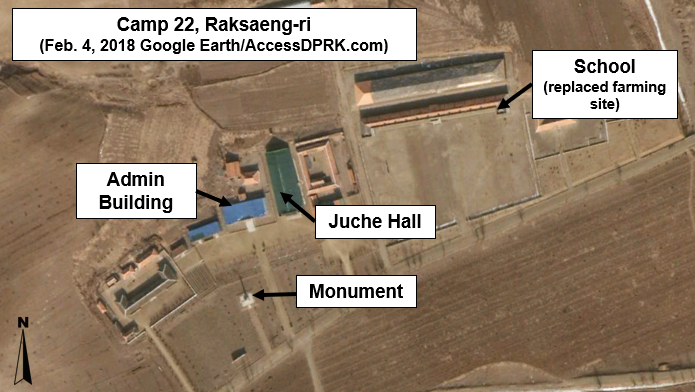
While the outline of the security fence system remains, the fences and guard towers have all been demolished. As well, during the 2012-2013 time frame, regular domestic buildings were constructed including town administrative buildings, Juche study halls, and monuments. These are items that are largely missing from prison camps but exist in practically every town and village in the country. This strongly suggests that the site has been turned over to civilian use, possibly as a non-penal exile site (as the main roads in and out of the former camp still retain access control points).


The largest changes to the former camp facilities, besides the removal of fencing and guard posts, seems to be the demolition of two buildings within the camp's administrative center, which includes the torture facility.

Camp administrative center in 2010 with buildings of interest.


Camp administrative center with unidentified building and the torture center demolished as of 2018.


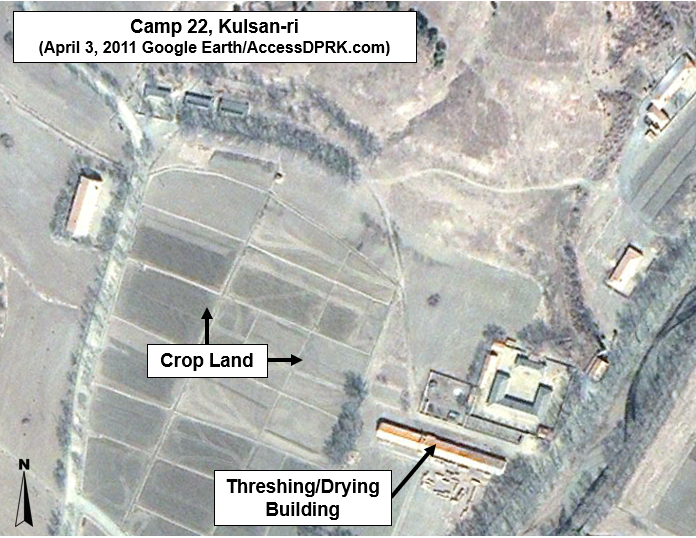
Changes to the villages within the camp attest to its current non-penal nature and shows that something did in fact change in the area's administration after 2012 when all of these changes began to appear.

Raksaeng-ri, a village within the camp as seen in 2011.

Raksaeng-ri after camp closure. Common civilian buildings have been constructed.


The village of Kulsan-ri in 2011.

Kulsan with a new school and other buildings as of 2018.


Agricultural and mining activities appear to have continued with little interruption since the closure as crops can be seen in various stages of growth and harvest over the years, and trains still visit the mining depot. However, the entrance points to the area are still controlled by check points. All of this leads me to believe that the camp is now being used for either one of two things.

The first is that is could now be a regular agricultural and mining area, however, the government still hasn't fully sanitized the former camp of bodies and other evidence that this was a terrible place and so needs greater control over who gets in and out.
The second is that this is a non-penal location used to send exiles and other non-criminal undesirables. The nearby county of Onsong (which also used to have a prison camp) and the northern reaches of the country in general have long been regions to which the government sent exiles. Pyongyang is regularly purged of "lesser" citizens and there are reports of "abnormal" people (like dwarfs) being rounded up and sent to places out of sight of the capital and visitors. 

There is a third option but it is unlikely, and that is that the camp is still a prison but is being administered in a radically new way.

The main entrance check point as seen in 2016.

It is an unequivocal positive that there is one less prison in North Korea, however the regime seems to show no real interest in doing away with political prison camps or mass internment in general. Prisons like Chongjin, Kaechon, and Chongori have all been expanded in the last decade and repression continues unabated.


--Jacob Bogle 11/1/18
www.JacobBogle.com
Facebook.com/JacobBogle
Twitter.com/JacobBogle

Friday, October 5, 2018

The Vatican's Abbey in North Korea

Few realize that Korea was once the most Christian region in Asia, particularly Pyongyang. In fact, Kim Il Sung's own father was a Protestant deacon. After the division of the Korean peninsula, Kim Il Sung began a mass purge of Christians and suppressed all forms of religion, including Buddhism and traditional folk beliefs. Several hundred former religions structures survived these purges and the Korean War, but they played an ever-diminishing role in the lives of the people. Today, only token "churches" and "temples" exist in the country, and a few Buddhist sites that are scattered around are left open as tourist spots.

By Kaliwallace, DeviantArt.

Just outside of the urban core of the coastal city of Wonsan exists a curious remnant of the former religious life of the northern Korean people. Although monks, nuns, and their associated religious buildings existed in the area since the 1920s, the Territorial Abbey of Tokwon wasn't established until 1940. It only managed to service the surrounding counties until 1949, as that's when things began to drastically change. In May 1949, North Korean secret police arrested the Abbey's 80 or so Catholic personnel (which included foreigners as well) and over the next several years 35 of them had died from execution, hard labor, and starvation. Among those who died was the Benedictine Abbot-Bishop Boniface Sauer, who died on February 1, 1950. In 1952 the remaining German monks and sisters were deported.

Wonsan University of Agriculture. Google Earth, Nov. 3, 2017.

The Abbey building itself suffered bombing damage during the Korean War, but it was later converted to secular use. It now sits on the campus of the Wonsan University of Agriculture. 
Some of the survivors established a new monastery in South Korea, and that monastery is the technical administrator of Tokwon - however no one is allowed to visit Tokwon and no religious services are held there. Despite the events of history and the reality on the ground, Tokwon is still one of the few official territorial abbeys of the Catholic Church, and the only one in Asia.

Tokwon Abbey building. Google Earth, Nov. 3, 2017.

Abbot-Bishop Boniface Sauer and the other Tokwon martyrs are now among over 100 North Korean Catholics who are under consideration for beatification. One of the major accomplishments of the monks and nuns of Tokwon was the translation of the New Testament epistles and the Book of Revelation into Korean.

Abbot-Bishop Boniface Sauer (bottom row, center) and the brothers of Tokwon. Image date unknown.

Christianity (all denominations) went from one of the largest faiths in North Korea, with over 1.7 million adherents prior to the Korean War, to as few as 11,000 mostly older followers. The only official Christian organization in the country is the Korean Christian Federation, which claims some 10,000 members. While the North Korean Constitution guarantees freedom of religion, it also bans any activities that may detract from the power of the state, organizations that could be tools of imperialism, and other related prohibitions. Under these vague terms, the state can suppress any religion it desires. Indeed, Christians in North Korea are considered the most oppressed religious group in the world and countless thousands have been murdered by the regime in concentration camps.

The newly completed Abbey. Original date and source unknown.

When Korea was divided, access to countless human stories and historical sites vanished from the face of the earth. We can use satellite images, defector testimony, and the ever-shrinking pool of living memory to help reconstruct the past, but the true story of the millions who have survived, endured, or died over the course of the past 70 years will only ever be known when North Korea is finally opened to the world.