Friday, May 19, 2023

Tee-up, North Korea's Golf Courses

Pyongyang Golf Club in 2015, prior to expansion program. (CC BY-SA 2.0, Uri Tours)

It is often erroneously reported that North Korea only has a single golf course. In fact, the country has three, but none are open to the general public. In this article, I'll examine each one and their current status.

The golf course (39.107805° 125.997879°) at the unofficially-named Samsok Mansion, along the banks of the Taedong River east of Pyongyang, was recently in the news because North Korea tested its Hwasong-18 intercontinental ballistic missile on April 13 from a launch pad mere meters away. 
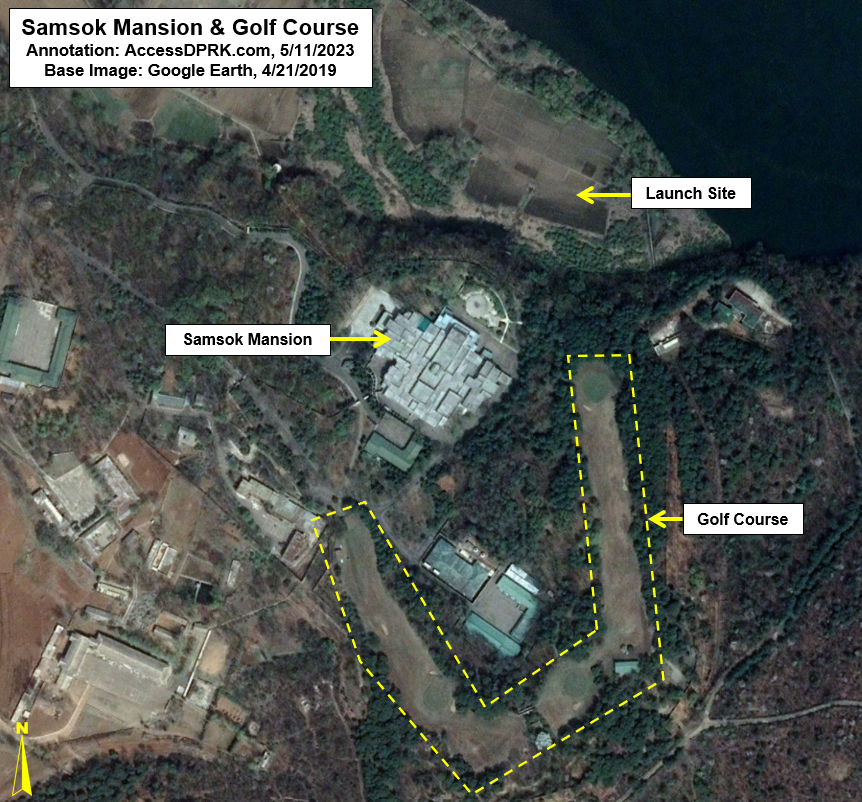
The launch site is located on an island within the mansion complex that was fitted out with berms and ponds (for an unknown reason) prior to the missile test. 

The golf course is the nation's smallest and was added to the mansion grounds in 1986. It consists of three holes with six sand traps which are arranged along a semicircular course running for 600 meters.

The mansion isn't one of the main residences for the Kim family, but it is surrounded by a dozen smaller villas set within a wooded landscape that are all interconnected by a network of private lanes. This suggests that the mansion serves as the center of a rural 'getaway' for the country's elite and provides a slower pace of life for those visiting.


Pyongyang Golf Club after 2017-2019 renovations.

The most well-known golf course, however, is the Pyongyang Golf Club (38.897281° 125.437426°). Located on the banks of Lake Taesong, this 18-hole course is part of a larger 16.4 sq. km. pleasure ground for the country's elite. Opened in 1987, it has been reserved for use by the country's wealthy and foreigners. 

In 2011 it began hosting the DPRK Amateur Golf Open, but there hasn't been a new tournament since 2016 despite attempts by several tourist groups to resume the competition.

Pyongyang Golf Club after most new construction had been completed in 2019.

However, that doesn't mean activities at the golf course have ceased. In 2018 plans were released by the government detailing an expansion of the Club. This included the addition of nine new holes, additional lodgings and other facilities.

Construction actually started as early as April 2017, with early landfill activities, but it began in earnest in 2018 and by February 2019 at least 13 buildings were nearing completion. Changes at the site also involved the creation of a small pond (by building a barrier to enclose a smaller portion of the lake) and the installation of a helipad which was finished by Nov. 2019.

Close-range ballistic missiles being launched on March 10, 2023 at Taesong Lake. Image: KCNA

Approximately 1 km north of the original club house is a peninsula that was meant to hold five of the nine new golf holes. Those have yet to be constructed but the peninsula did serve as the site of CRBM missile launches in March 2023. 


North Korea's third golf course was created as part of the Mount Kumgang Tourist Region (38.712675° 128.213664°) beginning in 2005. The course and grounds cover approximately 143 hectares and contains several lodgings/hotels, a clubhouse, and access to the floating Hotel Haegumgang.

The tourist region had been established as a joint DPRK-ROK venture, but the effort didn't last long.

The golf course in 2021 after years of neglect. 

Following the killing of a South Korean tourist in 2008, tourism from South Korea was halted. The North Korean government began to run domestic tours to the region in 2010 but these tours didn't generate much interest. 

For all intents and purposes, the golf course was shuttered soon after. Both sides have floated ideas to restart joint tourism, but nothing has come of these talks. 

In 2019 Kim Jong Un announced his intentions to rebuild and modernize the golf course and the whole tourist zone (regardless of South Korea's desires, as the area was largely financed by South Korea). This included the demolition of a hotel next to the golf course, the planned destruction of the Hotel Haegumgang, and other sites throughout the 530 sq. km. region.

As of late 2022, no new construction is visible, and the golf course has been allowed to decay. 


The former Yanggakdo Golf Course as seen in May 2011, a few months before its removal.

There had been a fourth golf course (38.997397° 125.750226°), one that was located on Yanggakdo Island in the middle of Pyongyang, next to the famous (or infamous) Yanggakdo International Hotel. But it was removed in late 2011 to make room for another hotel; however, that hotel still hasn't been completed.


I would like to thank my current Patreon supporters who help make all of this possible: Alex Kleinman, Amanda Oh, Donald Pierce, Dylan D, GreatPoppo, Jonathan J, Joel Parish, John Pike, JuneBug, Kbechs87, Russ Johnson, and Squadfan.

--Jacob Bogle, 5/18/2023

Monday, April 24, 2023

Construction at Huichon

Huichon is an industrial city in Chagang Province, North Korea that has been experiencing a construction boom over the last few years.

This latest round of work would likely not have occurred if it weren't for the completion of Huichon Hydroelectric Dam No. 2 - a project that was mired in complications and may have played a role in Kim Jong Il's death. The dam along with ten other hydroelectric generating stations built along the Chongchon River from ca. 2010-2019, have a combined generating capacity of 420,000 kW.

At the start of Dam No. 2's construction, approximately ninety multi-family housing buildings were also constructed in downtown Huichon that provided space for around 500 families. 

This current ongoing construction boom began in 2020. Some of the projects have been reported on by DPRK media such as in the Rodong Sinmun and in a television program titled "The Look of a New Town" which aired in July 2020. But others haven't been officially acknowledged yet. With that in mind, I'd like to highlight some examples that can be seen via satellite imagery. 


To start, there is a kilometer-long road tunnel (40.198067° 126.278119°) that connects two other projects I'll be discussing with the rest of Huichon and the Huichon Industrial Cooperative, which is a collection of factories near the center of the city. 

Satellite imagery reveals new spoils piles, suggesting that the interior of this tunnel is either being renovated or that the tunnel is being enlarged in some way.

The tunnel area as seen on October 2, 2020.

New work at the tunnel site as seen on Sept. 1, 2022.

Although the tunnel looks like a typical road and can be accessed from one of the city's main arteries, the road only leads to and from the Chilsong Electrical Appliance Factory. This feature becomes more interesting when you consider that the hill it runs through contains a warren of other tunnels, suggestive of a large underground facility (discussed further below).


Chilsong Electrical Appliances Factory as seen in 2018.

This tunnel leads directly to the Chilsong Electrical Appliance Factory (40.202665° 126.278621°) which is in the process of being completely rebuilt.

Little is publicly available about the specifics of the factory, but Kim Jong Il visited it in March 2010 and said that the factory was an important part of the country's economic future. However, that's the only leadership visit to the factory I can find in online sources. Regardless of the exact role of the factory, the fact it is being doubled in size attests to its continued importance. 

The factory is undergoing expansion. As seen in November 2022.

In 2018, the overall factory area covered approximately 12.5 hectares. In 2019/2020 the old factory was demolished and construction of a new factory campus began. This new area covers approximately 30 hectares and includes not only typical industrial buildings but will also have a stadium (somewhat common at large industrial sites), factory museum, revolutionary history/Juche museum, a health clinic for workers, and other amenities. 

The early stages of construction seem to have been carried out quickly, but it has since stalled. Little new activity is visible between October 2020 and December 2022. This may be a reflection of the COVID-19 pandemic's economic toll on the country.


Foundations for new apartment blocks across from the Chilsong Factory.

Across from Chilsong (at 40.208419° 126.281558°) the foundations for 21 apartment buildings have also been constructed, perhaps as new worker housing for the expanded factory. Previously, only farmland and a few small houses existed on the site, but they were cleared away for the new apartments sometime between 2019 and 2020. However, like the stalled progress on the factory, only the foundations of the apartment buildings have been constructed, and the work appears relatively inactive as of Dec. 2022.


As mentioned earlier, the Chilsong factory is connected to the rest of Huichon via a tunnel. The hill the tunnel runs through has several other smaller tunnels that indicate the presence of a large underground facility (UGF) at 40.188214° 126.275511°.

The hillside is encircled by a newly built 3.5-km-long perimeter road (yellow) that can also be used to reach Chilsong and that connects to the six other tunnels (white) clustered at the southwest of the hill. There is no way to know how the tunnels are actually arranged or if there are large rooms within the hill, but I've created a speculative map of the interior tunnel arrangements based upon the location of each entrance and service adit.

There are three main entrance points to the hill. These are located together, and each entrance is protected by a small, covered structure. Previously, a series of greenhouses existed on the site as well but those have been demolished. 

Excluding the main road tunnel, if my estimated tunnel layout is considered, there are at least 3 kilometers of tunnels inside the hill.

After reviewing the available imagery, there isn't enough visual evidence to say if a factory complex exists underground or if the site is being used as a hardened storage facility. However, other "electrical appliance" factories are known to be involved in North Korea's armaments industry, and the closed-off nature of the underground facility and Chilsong factory raises further questions.


The Huichon COVID-19 isolation ward.

Within the new complex of the Chilsong Factory is one of over 80 (and counting) suspected COVID-19 isolation wards. Located in an out-of-the-way building (40.201310° 126.281072°) at the inactive construction site, the COVID ward was established in 2021. The 180-square-meter building is surrounded by a wall, has two guard posts, and all of that is surrounded by a perimeter fence. 

Public information is sparse about these facilities, but because of their high security and relatively small size, I surmise that they are used to isolate those who test positive for COVID-19 or have an otherwise unidentified fever until they either recover or need to be transported to a hospital that can provide intensive care (at least, North Korea's version of intensive care). 


As part of the overall construction in the Huichon area, this school (40.205530° 126.244176°) and nearby housing have been reconstructed. The school will be 2-3 stories in height and there have been 14 new housing buildings constructed. Each building contains 2-4 individual housing units.

Across the river from the school a further 78 houses were built totaling 156 family units. The houses are in the new "countryside" architectural style promoted by Kim Jong Un in recent years.


The last construction project I want to discuss is the ongoing work at the Hagap Underground Facility (40.081244° 126.188535°).

Hagap is an underground complex 13-km south of Huichon that has an uncertain purpose. Construction began in 1991 but after several years of work it was apparently never completed. Following a prolonged period of inactivity, activity resumed in 2016. I have written about the progress at Hagap a couple of times (in 2017 and in 2019), and work is still ongoing.

Construction activity in 2016-2019 had been focused on improving access roads and building new tunnels, but since 2019 temporary worker's housing and workshops were constructed at the front of the complex, suggesting work is now being carried out in the interior of the main underground area.

As seen in the above image, construction work and landscaping have been completed at this auxiliary entrance site.

Secret nuclear facility, underground state archive, or something else, after 32 years of construction Hagap's purpose still isn't known. However, unlike the neglected underground facility at Kumchang-ni, North Korea seems intent on giving Hagap life and warrants continual monitoring.


I would like to thank my current Patreon supporters who help make all of this possible: Alex Kleinman, Amanda Oh, Donald Pierce, Dylan D, GreatPoppo, Jonathan J, Joel Parish, John Pike, JuneBug, Kbechs87, Russ Johnson, and Squadfan.

--Jacob Bogle, 4/23/2023