Sunday, September 27, 2020

Open-Air Theaters Spread Across the Country

A hallmark of Kim Jong Un's rule has been the creation of entertainment centers. Be they amusement parks, ski resorts, children's traffic parks, and even "4D" theaters, new recreational facilities have popped up all over the country.

Packed house during the reopening of the Pyongyang Youth Open-air Theater. The theater was first built in 1959. KCNA Jan. 17, 2020.

Included in that mix are open-air theaters. Coinciding with the renovation of the Pyongyang Youth Open-air Theater, new theaters are under construction in nearly every provincial capital and some select other cities. In Chongjin, Haeju, Kanggye, Nampo, Pyongson, Rason, Sariwon, and Sinuiju, construction is well under way or nearly completed. Hamhung's theater is in the very initial stage of construction, and Wonsan already has an established open-air theater. 

The construction of most sites began in 2018 but has yet to be fully finished at any of them except for the refurbished Pyongyang theater.

Plays and film have always loomed large in North Korean culture with nearly every town having a traditional movie theater built/rebuilt almost immediately after the Korean War. Kim Jong Il, especially, loved movies, plays, and opera. He wrote numerous letters and books on the subject, including On the Art of Cinema and On the Art of Opera. Each explaining in detail his views on the subjects and how they can best serve the state's goals through "socialist art" and as tools of indoctrinating the people with correct forms of thought.

And while everyone in the country knows they're being propagandized to, a lifetime of exposure has taught them to tune out the obvious stuff and enjoy the stories themselves. Indeed, North Korean's are quite the vocal art critics - in their subtle ways to avoid accidentally criticizing the regime. A good film, play, or song will rapidly make its way through the cities and into the countryside.

Soon after Kim Jong Un came to power, in recognition of the people's love of film, "4D-rythmic" theaters began to be built and now there's one in most large cities. With their distinctive architecture, they're easy to spot.

Built in 2014-2015, the 4D theater now sits just 100 meters away from the new open-air theater. These facilities are on the grounds of the former Nampo Sports Village. Built in 1973, only the stadium and regatta course were ever completed.

Participation in "mass-based art" has long been promoted with, "All provinces, cities, counties, industrial establishments and cooperative farms across the country have halls of culture, libraries and reading halls. Theatres and halls of culture in different parts of the country are equipped with facilities and musical instruments necessary for cultural and emotional life and artistic activities of working people." - Naenara, July 20, 2020

There is some variation in size with each of the new open-air theaters, ranging from 65-80 meters front-to-back and 85-100 meters at the widest. The existing Pyongyang theater is approximately twice the size as the newly built ones.

Sinuiju theater still under construction as of Nov. 27, 2019.

In the case of Sinuiju, there are 38 rows of seating arranged on three levels and into 13 sections. The Pyongyang Youth Open-Air Theater has seating for 10,000 and the theater in Haeju is said to have a seating capacity of 5,000. Given that Haeju is closer in size to the others, all of the new theaters probably have a seating capacity ranging from 5,000 to 7,000.

These theaters are also used for things other than plays and performances. Films can be shown, lectures given, and educational classes are provided. This not only makes them an important part of North Korean culture but they also provide the state with another venue for instilling propaganda and disseminating the wishes of the Korean Workers' Party. 

Primary construction of the Rason Open-Air Theater only began this year. As of July, there was still a lot of work left to do. While most theaters are located amongst the rest of the town, Rason's is positioned 200 feet above on a hillside overlooking the bay. No doubt the views will be great once it's finished.

The Pyongyang theater had a set of solar panels added to its roof. It is likely that the other new theaters will also include solar power. This fits in with the country's incremental adoption of green energy solutions to their otherwise extreme electricity shortage. 

Provincial capitals usually have a handful of distinctive features (like joint murals of Kim Il Sung and Kim Jong Il) that other cities tend to lack. However, certain things eventually make their way into other important cities after their popularity has been assessed in the capitals. I wouldn't be surprised if these open-air theaters end up spreading to a few more cities in the coming years.


I would like to thank my current Patreon supporters: Amanda O., Andres O. GreatPoppo, John Pike, Kbechs87, Planefag, and Russ Johnson.

--Jacob Bogle, 9/26/2020
AccessDPRK.com
JacobBogle.com
Facebook.com/accessdprk
Twitter.com/JacobBogle

Wednesday, September 16, 2020

Markets Still Grow Despite Economic Headwinds

Researching North Korea's economic development is always fraught with difficulties. The state offers very little in the way of concrete data, and state media predominantly focuses on single items (like a factory or amusement park being built) and gives exaggerated reports on national trends. At least, until Kim Jong Un came to power. 

While the amount of reliable information is still sparse, Kim Jong Un has broken with tradition and hasn't been afraid to speak openly about the difficulties facing the country. He has even blamed the bureaucracy itself on occasion instead of always chalking up problems to sinister western forces or on a single bad administrator.

Pyongyang Central District Market. Yonhap, 2006.

It is clear that the people's lives have improved since the days of Kim Jong Il but to what extent that trend has carried on into the last few years is murky and appears to be fairly uneven. How much the civilian and military economies have undergone structural changes under Kim Jong Un is likewise murky. However, all one has to do is pull up Google Earth to see billions worth of construction activity over the years, and to examine their missile tests to tell that Kim has certainly surpassed his father in the military sphere. 

Now, before you start accusing me of calling Kim Jong Un a reformer, I'm not. But it is irrefutable that his governing style - while still autocratic - is somewhat different from that of his father's. Many of the obstacles and opportunities facing this generation are also fairly different than the ones facing the famine generation, so, naturally, the economic dynamics are going to change.


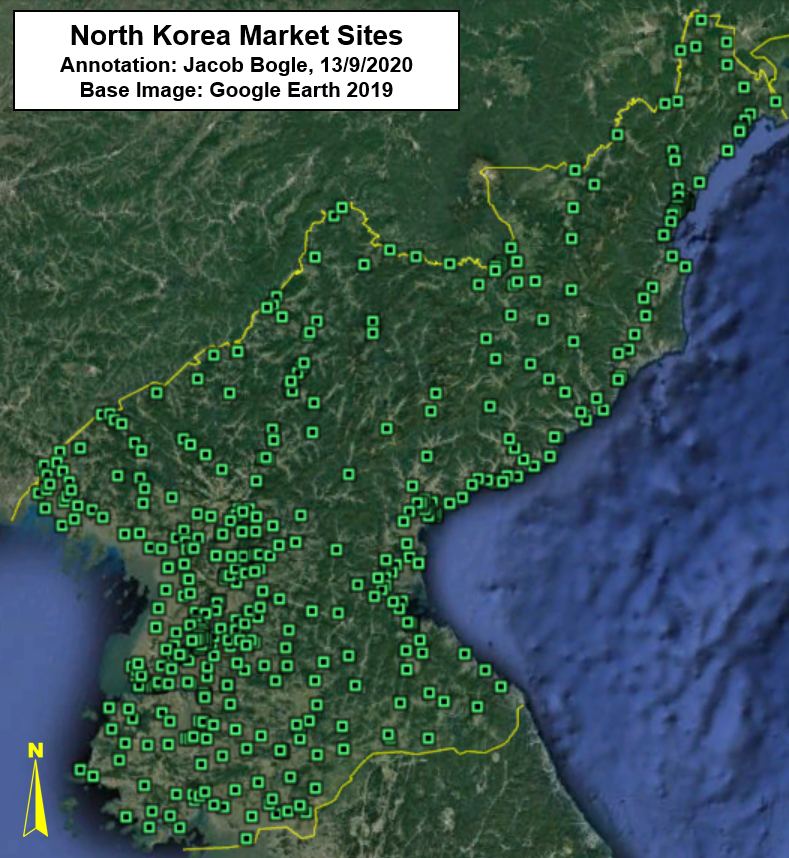
Markets for things like handicrafts have always been allowed in North Korea, but markets for selling grain, consumer goods, etc. were forbidden. That all changed during the course of the famine when farmers' markets popped up along roadsides across the country as people picked survival over obeisance to the state. In turn, the government has sought to regulate them (thus giving tacit approval to their operation), and according to the Center for Strategic and International Studies (CSIS), the state earns between $60 and $70 million annually from fees and taxes imposed on the markets as of 2018. Over the past decade or so the number of approved markets has roughly doubled, and as of this year, I have been able to identify 443 of them. 


This implies a fairly robust civilian economy, even if it is faced with numerous obstacles (particularly in 2020 as the result of COVID-19 and after multiple typhoon impacts). Specifically, the service sector, retail, and construction have all been growing drivers of the economy for at least a generation.

How much of this can be attributed to the fact Kim was left an "inheritance", reportedly worth up to $5 billion, that he was able to invest in weapons and economic construction, how much is due to illicit trading activities, and how much may be due to a civilian economy that has become even more market-oriented despite the regime's protestations can't fully be known. Regardless, the results are the same.

To demonstrate that the civilian economy is still growing despite internal and external economic pressures (including sanctions), I want to show some changes that can be seen in 23 markets across the country. (A list of these markets can be found at the end of the article.)

These changes have all taken place from 2015 to 2019 and includes markets in major cities and in more rural areas. The changes are: the building of entirely new markets and the expansions of existing ones.

Since 2015, at least thirteen new markets have been constructed with a combined area of approximately 47,271 square meters (508,820 sq. feet) of new selling space. The largest of the new markets was constructed in Chollima (Kangson) in 2019 and ranks among the largest markets in the country, covering 15,920 sq. m (171,361 sq. ft.).

Google Earth image showing the recently constructed market. An overflow crowd is also visible.

Additionally, since 2015 at least eight other markets have undergone relatively substantial expansions, and two more were converted from open-air markets to being housed in buildings. Between the expansions and added covered floor space, the total additional area equals 18,906 sq. m (203,502 sq. ft.).

The result of these changes is that there has been an increase of 66,177 sq. m (712,323 sq. ft.) worth of market space in just four years.

According to CSIS, the largest market in the country generates the equivalent of $36/sq. m in revenue to the government each year. If we make a simple assumption that these new spaces will generate only $15 per square meter, that still represents nearly an extra $1 million a year going to Kim Jong Un's coffers (solely from fees and taxes at the markets). The regime generates additional revenue through the process of transporting goods, trading permit fees, paying bribes to border guards and officials, etc. 

The fact new markets were also built after 2017, when economic sanctions against North Korea reached their height, tells us that the country's domestic economy and illicit trade is likely more robust than is generally thought. 

This is backed up by Panel of Expert reporting by the United Nations that claims the country could be illegally importing three to eight times the amount of petroleum products it is legally allowed. That also helps explain how the regime has been able to build scores of gas stations in recent years which are estimated to consume the equivalent of the country's entire legal fuel import amount. Other illicit trading involves coal, seafood, and even sand exports.

And while COVID-19 has placed a tremendous strain on the economy, North Korea is still managing to build the largest hydroelectric project in its history, construction of the Pyongyang General Hospital is nearing completion, and the capital has embarked on a housing building boom.

Additional projects like multiple small hydroelectric dams, large collective farms (such as the Jangchong Vegetable Farm), and various construction projects that can be found in most medium and large-sized towns, all point to a country that is not stationary. 

Clearly, the misallocation of resources on things like nuclear weapons and future missile tests places a burden on economic growth. And the extremely poor state of the country's electrical grid, transportation system, and healthcare network means the country is in many ways still trying to fully recover from the downfall of the 1990s, but economic progress can nonetheless be seen.


I would like to thank my current Patreon supporters: Amanda O., Anders O., GreatPoppo, Kbechs87, John Pike, Planefag, Russ Johnson, and Travis Murdock.

--Jacob Bogle, 9/14/2020
AccessDPRK.com
JacobBogle.com
Facebook.com/accessdprk
Twitter.com/JacobBogle


Notes
The 13 newly constructed markets are located in: Chollima (38.931° 125.561°); Jonchon (40.616° 126.459°); Kag'am-dong (39.565° 125.851°); Kangdong-Pangwha (39.161° 126.023°); Kimchaek (40.674° 129.181°); Kumya (39.540° 127.246°); Samjigang (38.412° 125.691°); Nampo A (38.753° 125.396°); Nampo B (38.735° 125.418°); Pyongsan A (38.335° 126.393°); Pyongsan B (38.327° 126.412°); Riwon (40.319° 128.663°); Sariwon (38.509° 125.767°)

The 10 expanded markets are located in: Chollima (38.928° 125.560°); Chongjin (41.790° 129.767°); Chongju (39.696° 125.219°); Hamju (39.855° 127.435°); Kangdong (39.138° 126.094°); Koksan (38.782° 126.669°); Sin'gye (38.500° 126.524°); Songang (37.887° 125.154°); Wolthan (41.413° 127.057°); Wonsan (39.175° 127.378°)

Friday, August 21, 2020

Renovations at Elite Hot Springs Appear on Hold Due to Economic Pressures

 
While Kim Jong Un was busy issuing orders to reconstruct the city of Samjiyon, to build kilometers of beachfront resorts in Wonsan, and constructing a new hot springs facility in Yangdok, he wasn’t going to neglect Onpho in the process.

Nestled in a valley a few kilometers northwest of the city of Kyongsong in North Hamgyong Province, the Onpho Holiday Camp, a hot springs resort, has been popular among the country’s elite for decades.

The original facilities at the Onpho hot springs resort as seen on Sept. 29, 2017. 
 
It is one of the oldest and largest such facilities in the country and has been visited by each generation of the Kim family. It is so popular to the elites that a secured villa complex was built next to the general spa area and a special “leadership train station” was added around 2010 to allow for speedy and secure transportation to the relaxing hot springs and mountain air that flows down into the valley.

However, during Kim Jong Un’s visit to Onpho in July 2018, he lamentedits very bad condition, saying bathtubs for hot spring therapy are dirty, gloomy and unsanitary for their poor management.”
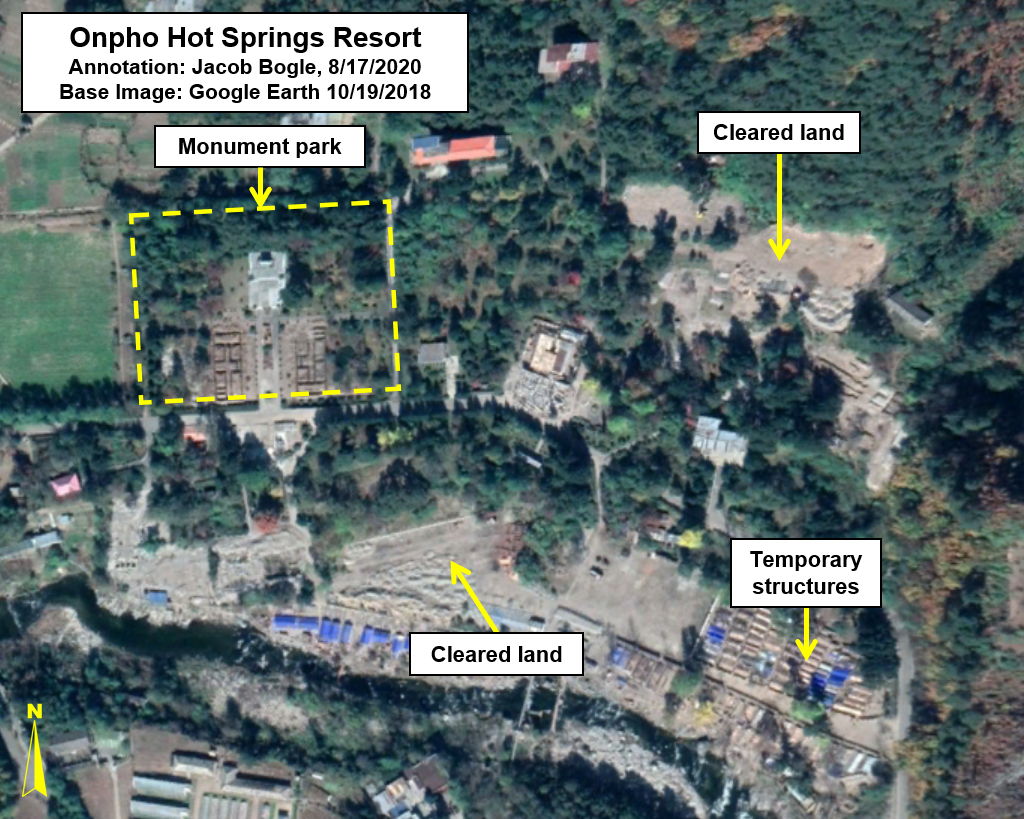
By October, Google Earth images revealed that the resort was being renovated as temporary worker’s housing was visible as well as the land being cleared for new buildings.

Initial work activity at the resort in October 2018, with various temporary structure like worker’s huts and workshops visible.
 
After that initial activity, construction slowed down and little had been accomplished five months later in March 2019. That lull quickly changed as by September, at least fourteen buildings were under construction in the main resort area and a dozen multifamily housing structures were also being constructed across the river for employees of the spa.

During Kim Jong Un’s 2018 visit he mentioned that the bad condition of Onpho would “commit a sin” by drawing criticism from the people in a place that was so important to Kim Il Sung and Kim Jong Il. Testifying to Onpho’s importance, it has an entire park and monument dedicated to the “exploits of the great leaders” with regard to the establishment of the resort.

The historic importance of the resort was commented on by the Korean Central News Agency back in 2015 when they stated that Kim Il Sung had visited the natural hot springs at Onpho as early as 1946 and ordered it be turned into a holiday camp. He then visited and gave “field guidance” a further twenty times, followed by visits by Kim Jong Il including one trip in 2008 after the area had been hit by flooding.

Kim Jong Un has made it a key feature of his rule to (attempt to) improve international and domestic tourism by spending hundreds of millions of dollars – perhaps a billion or more in total – constructing numerous tourism related facilities across the country including a $35 million ski resort, converting the Wonsan-Kalma area into a major tourist region (which included an estimated $200 million reconstruction of the Kalma International Airport), and more recently, discussing the need to modernize the Mt. Kumgang Tourist Zone that was opened as a joint project with South Korea back in 1998.

All of this, of course, despite the fact that North Korea doesn’t have hordes of foreign visitors to fill up those thousands of hotel rooms now available nor does it have a strong enough domestic economy to sustain all of the resorts with predominately local tourists.

However, the fact that Onpho plays a role in the Kim family personality cult and that it has been a longstanding feature the state could point to as evidence of Kim Il Sung’s love for the people, it makes sense that Kim Jong Un would want to renovate such a place that had become dilapidated.

Unfortunately for the regime, economic pressures don’t care about prestige projects and there has been very little new construction during all of 2020 as late as July.

The combination of existing economic problems and the added pressures relating to the COVID-19 pandemic have caused considerable difficulties for the country. As a reflection of this, it was reported by DailyNK on April 23 that the regime sent out a jointly signed document by the Cabinet and Central Committee of the Korean Worker’s Party decreasing the number of “national construction projects” from fifteen to just five.

While the report didn’t say what those fifteen projects were, two of the remaining ones are undoubtedly the Pyongyang General Hospital and the Tanchon Hydroelectric Project. Both have experienced funding and material shortages, with Kim Jong Un lashing out at officials over mismanagement regarding the hospital’s construction.

Onpho may be an ideologically important site but it isn’t fundamental to the country’s health or electricity needs, so the lack of construction this year may well be a reflection of economic problems and the April “joint decision document” cutting back on less practical projects.

The one area inside the large resort complex that hasn’t seen any renovation, somewhat conspicuously, is the leadership villa compound adjacent to the main spa facilities. This walled compound contains a primary palace building and six smaller villas.

The villa compound at Onpho.
 
After Kim Jong Un came to power, he wasted no time making improvements to a number of leadership residences including the addition of runways (such as at Hyesan and Changsong), he completely rebuilt villas within the “Forbidden City” district in central Pyongyang, and he undertook multiple changes to the Kim family primary Ryongsong Residence complex.

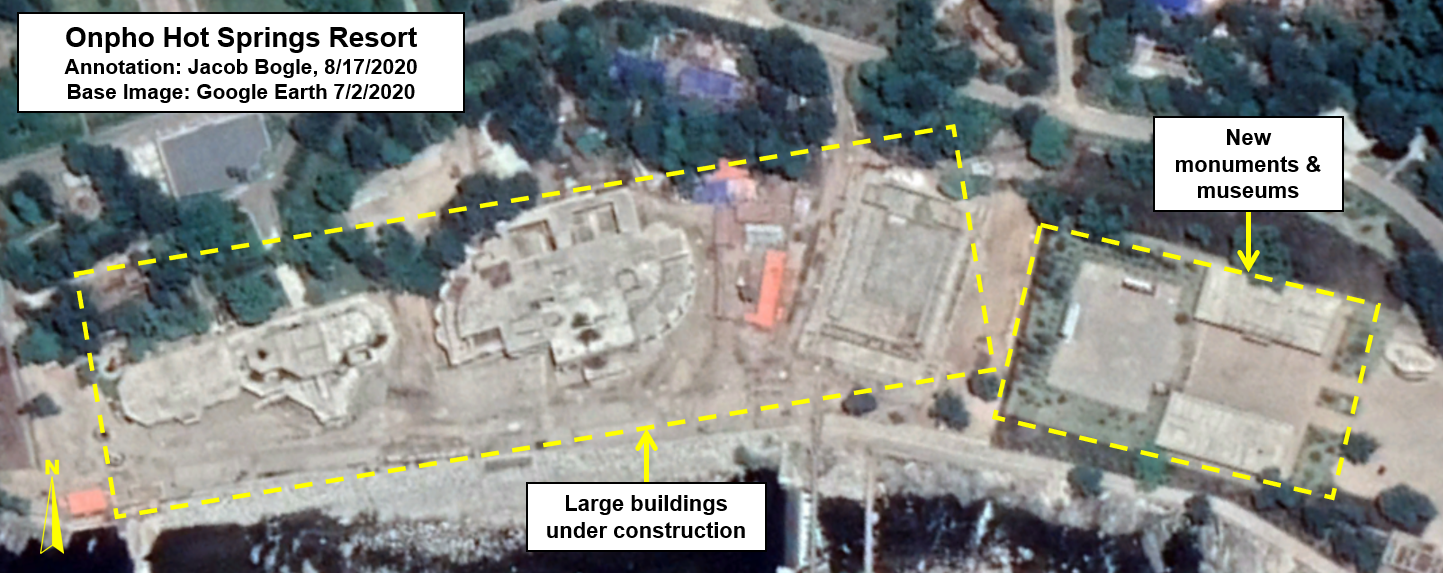
Nonetheless, what can be seen from commercial imagery does show substantial changes occurring at the holiday camp area. In addition to the hotel buildings (each around seven-stories tall) and new personnel housing, three unidentified but large buildings are also under construction. Located on the banks of the river, the three buildings have a combined footprint of approximately 6,814 square meters and are each multistory buildings.

Google Earth image showing the status of renovations on October 25, 2019.
 
Image dated July 2, 2020 showing only limited construction progress since 2019 except for the apparent completion of the new monument and museum park.
 
Additionally, a new monument area has been constructed that, as of the most recent Google Earth imagery, has two monuments and two buildings that are likely “revolutionary history museums” dedicated to Kim Il Sung and Kim Jong Il. Such monuments and museums are common to ideologically important places and places that have received multiple visits by the leadership. And in true North Korea fashion, this portion seems to be the first new part of Onpho to have been completed; the final landscaping touches being visible by July 2, 2020.

Construction may have been stalled due to unforeseen events, but the addition of Onpho to the long list of recreational facilities that Kim Jong Un has either built or modernized shows that “bread and circuses” are still a central tenet of his regime. From diplomatic maneuvers to testing missiles, to spas and rebuilt towns, every dictator needs a well-rounded legacy to go along with the less-than-voluntary labor it often takes to build these places.


I would like to thank my current Patreon supporters: Amanda O., Anders O., GreatPoppo, Kbechs87, Planefag, Russ Johnson, and Travis Murdock.