Despite all of the things we see and learn during North Korea's military parades and missile tests, only a fraction of the real story gets told (and often a fair amount of obfuscation is mixed in as well). Public knowledge of their ballistic missile program is still extremely limited though new discoveries do come to light.
Not every missile or vehicle is openly shown, and there are many deployed weapons systems and other equipment that have never been disclosed. Likewise, the infrastructure and training programs for their Strategic Rocket Force is largely unknown. And, North Korea has a habit of doing things just unusual enough as to baffle experts around the world.
In comparison to the United States and Russia/USSR, they test rockets and fire missiles far less often before beginning to mass produce them and place them into service. Their ability to indigenously manufacture the vehicles needed to transport and launch their missiles (especially the more modern versions) has often been viewed as lacking, but somehow, they end up with the equipment they need. Sometimes this is accomplished by converting large trucks from China and elsewhere, but it seems that their domestic capabilities may now surpass the limited capabilities usually described in public intelligence reports.
Though this exact process is not fully understood, as WMD expert Melissa Hanham remarked in regard to the 11-axle transporter erector launcher (TEL) seen during the Workers' Party 75th anniversary parade in 2020, "It is also clear that they have built up their manufacturing sector to indigenously modify - and now potentially produce - their own missile launchers."
So, we are often left to dissect photos from state media, parse through the vague language of government and military officials, and use commercial satellite images to look for clues and try to learn what the DPRK doesn't want us to. That’s the purpose of this article, to use what is available to try and paint in some of the picture regarding North Korea’s TEL development.
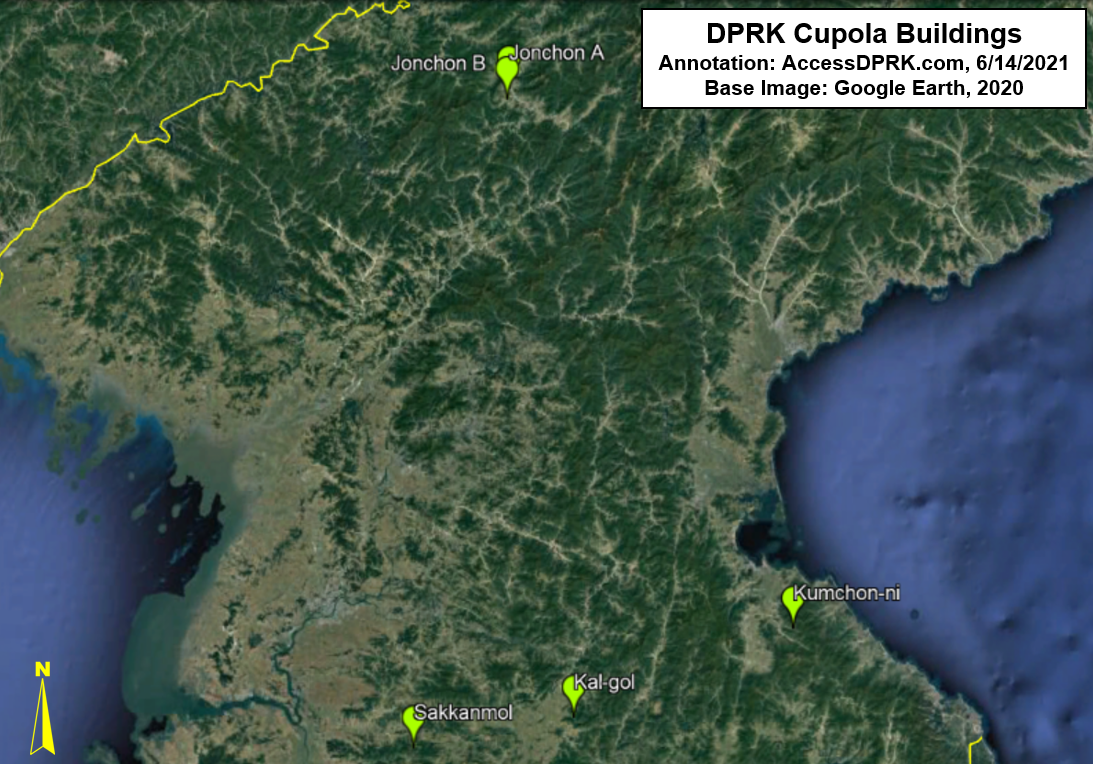
Locations of the five extant TEL-cupola facilities.
One such little-known cog within North Korea's vast missile infrastructure are five (formerly six) unusual buildings that have been described as "clearstory cupolas". Their exact nature is not known, at least not publicly, but it is surmised that they play a role in both the development of new TEL designs and a role in the maintenance of deployed TELs, and in training their Strategic Rocket Force.
They take on two main designs, one is a modified section of roof of a larger, high-bay building and the other is a small building that is basically the modified roof section itself but placed on the ground as its own independent structure.
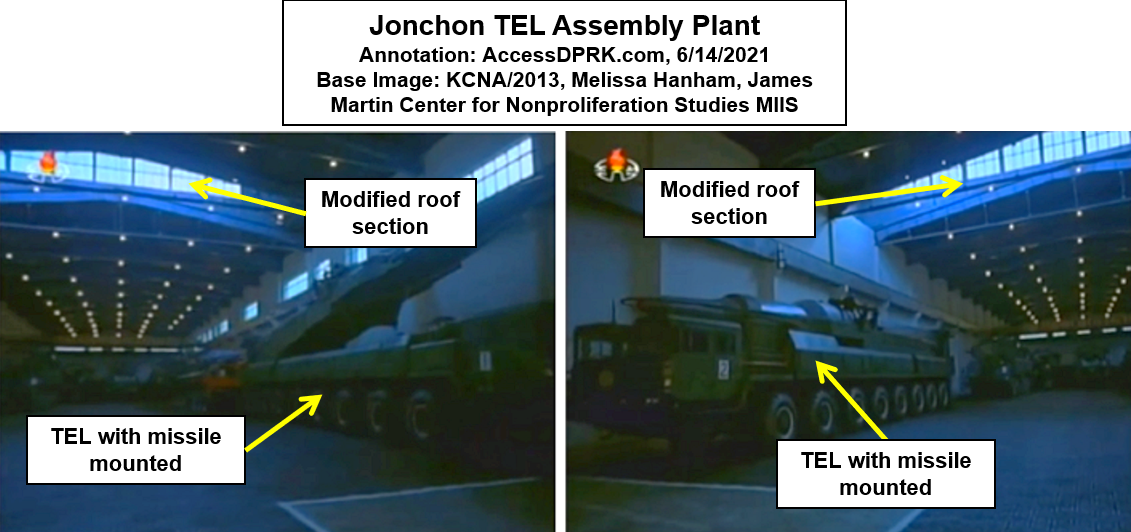
The most well-known of these little-discussed structures is the Jonchon TEL Assembly Plant that was written about in 38 North's "That Ain't My Truck", in which the authors hunt down the location of this special building after it was first shown in a state propaganda film.
Of the inventory of these formerly six (now five) buildings, two are located at known TEL/arms assembly factories, one was located at a missile-related facility, and three were built after 2011 at known missile operating bases stationing short range- and medium range- ballistic missiles.
The city of Jonchon has two of these facilities. The first is what was shown in the 2013 Korean Central TV program and discussed by 38 North. It is located at 40.645677° 126.432921°.
In 2004 the cupola structure was approx. 11 meters long by 6 meters wide.
By 2011 the cupola structure had been enlarged to ~20 meters long and 6-7 meters wide. Exact measurements can be difficult to acquire using Google Earth.
The following are models of the Jonchon TEL Facility.
Building model by Melissa Hanham, James Martin Center for Nonproliferation Studies. Used with permission.
This interior view shows not only the cupola but a KN-08 TEL with missile raised. Missile and TEL model by Frank Pabian and Tamara Patton; building model by Melissa Hanham, James Martin Center for Nonproliferation Studies. Used with permission.
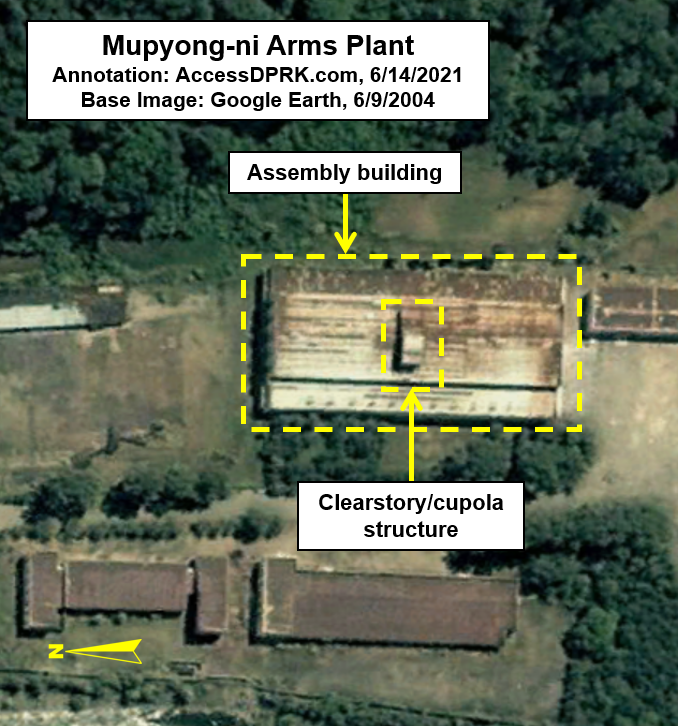
The other Jonchon facility is locate a short 3.7 km south at the Mupyong-ni Arms Plant (40.612031° 126.426428°).
In 2004, the cupola was 15 meters long.
As with the TEL assembly plant, the cupola was enlarged here, too. It was expanded to 20 m in length (also increasing its height), making it capable of handling newer, larger generations of missiles.
The Mupyong-ni Arms Plant was the site of a 2017 test of the
Hwasong-14 ICBM. A
monument was erected at the plant to commemorate the launch.
The other sites are as follows:
Sakkanmol Missile Base (38.582871° 126.082998°). Unlike the two in Jonchon, the Sakkanmol facility is a stand-alone cupola structure, not attached to any larger building. It was constructed sometime between 2011 and 2013.
The simply built structure is 16-17 m long by 7.5-8 m wide.
Sakkanmol is home to MAZ-543 TELs which carries the Hwasong-5 short-range ballistic missile, and the base is capable of deploying the Hwasong-6 and could be modernized to accommodate larger missiles. According to
Beyond Parallel, the base has 9 to 18 TELs/MELs stationed at it.
Kal-gol Missile Base (38.684702° 126.720857°).
Kal-gol's cupola building was constructed in 2012. It consists of a 31 m long building with a cupola structure that is 14.5 m long by 3 m wide. Like Sakkanmol, it is a short-, medium-range ballistic missile base and has the Hwasong-6 and Hwasong-9 missiles deployed there.
Beyond Parallel's 2020
report on the base noted the existence of the clearstory cupola facility and supports the idea that they are used for TEL/MEL maintenance and training purposes.
The report also stated that the arched clearstory, "reaches a height of approximately 13-15 meters. This height allows for the elevation of a Hwasong-5/-6 missile (and potentially the 13.5-meter-long Hwasong-9 (Scud-ER) depending upon the level of the floor) on a TEL or MEL for both training (especially during the harsh winter months) and maintenance. The latter would ease the burden of depot-level maintenance requiring a TEL or MEL having to be sent back to the factory for repairs or upgrades and reduces the length of time that a launcher is away from its parent unit. However, this clearstory building is too small for larger missile systems such as the Hwasong-12, -14, and -15."
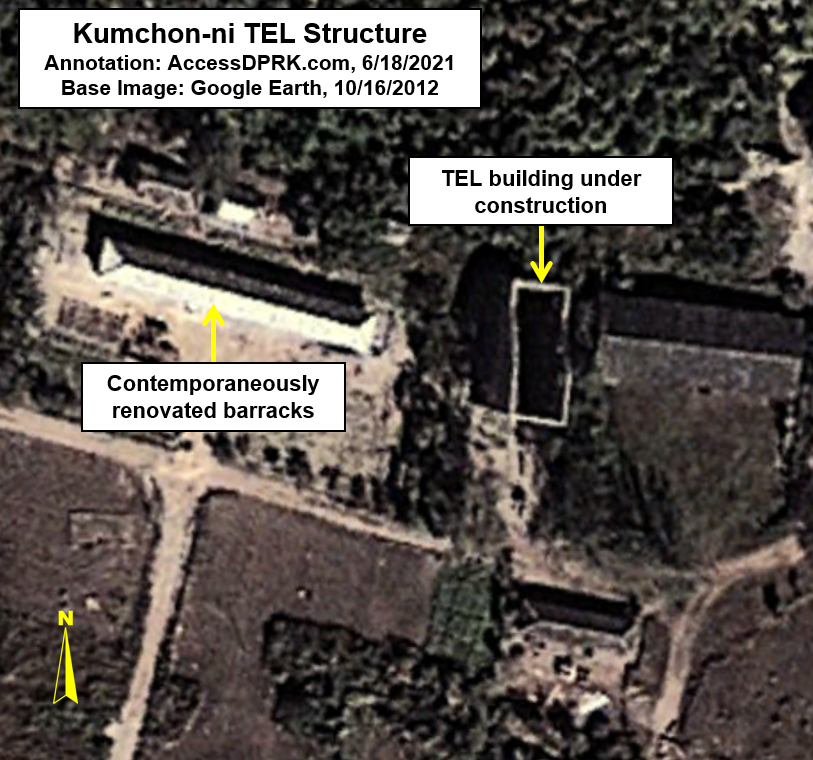
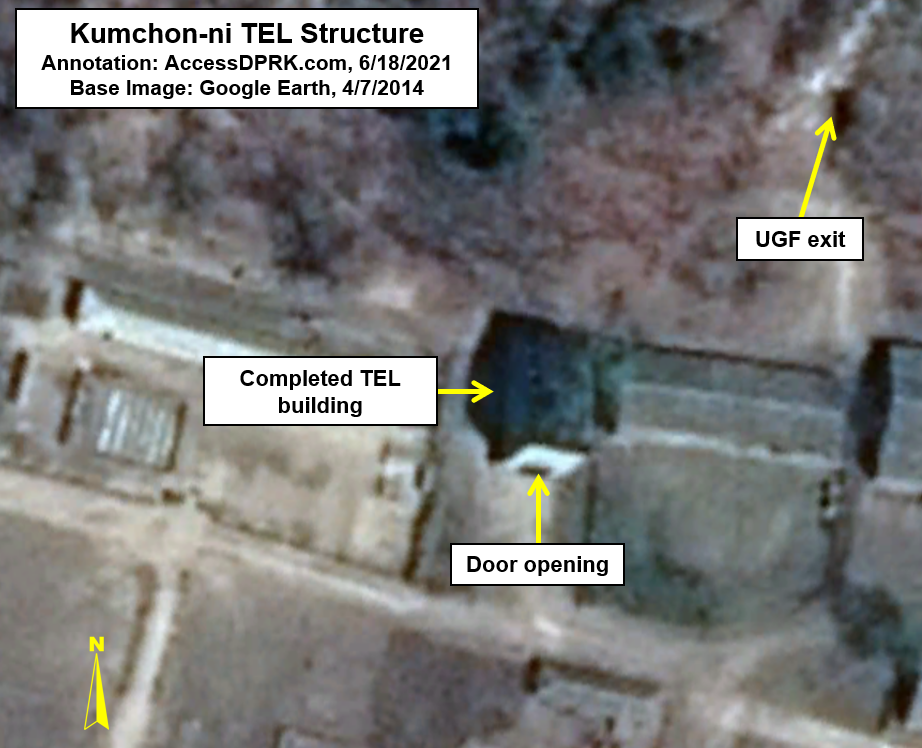
The last existing facility is at the Kumchon-ni missile base (38.964928° 127.597185°).
The TEL building at Kumchon-ni was constructed in mid-to-late 2012 and is 18-19 m long by 8-9 m wide. A set of adjacent barracks were joined into a single building at the same time. Unlike the other TEL structures, this one was built against a hillside, where the others are in more open terrain.
However, like Sakkanmol and Kal-gol, Kumchon-ni is within the "
tactical belt" of North Korea's ballistic missile base network. These bases house short- and medium-range ballistic missiles and would be involved in any first-strike against South Korea or even parts of Japan, as well as targeting US forces within South Korea. They would also be among the first locations to be attacked, and so ensuring proper training and that operational readiness is maintained is of the utmost importance.
Generally, these buildings are large enough to accommodate TELs/MELs for the KN-02, KN-23, KN-24, KN-25, Hwasong-5, -6, -7, and -9, and possibly the Hwasong-10 and Pukkuksong-2. (See also:
Missiles of North Korea by CSIS)
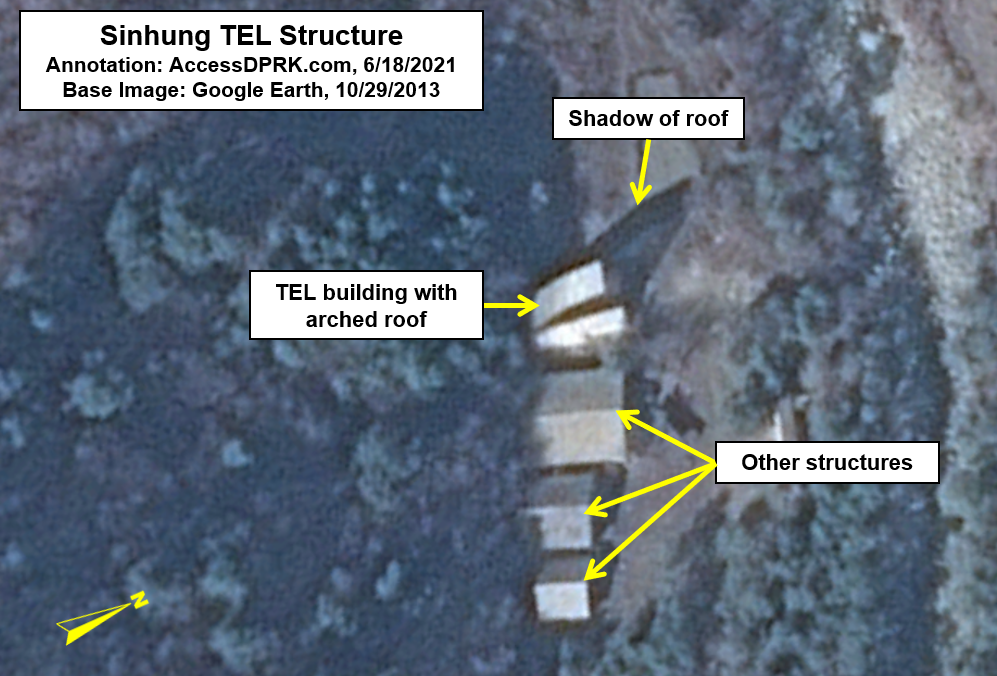
A sixth facility used to exist until it was demolished in 2020. Located much farther north than the missile operating bases mentioned, near the town of Sinhung, is a missile-related complex at 40.260594° 127.490231°.
The structure was 9-10 m wide and 20 m long.
Abutting a hillside, the Sinhung TEL structure was demolished ca. Feb. 2020.
Only an empty foundation remains today. However, at roughly the same time that the site was being demolished, another building was being constructed about 1.1 km west.
This new building is ~67 m long by 17 m wide and has a large hole in the roof that's 25 m long by 5 m wide. This could be a new larger cupola facility under construction, like the two in Jonchon, and would be used to develop larger TELs, as the opening for the clearstory section is bigger than at either Jonchon facility. Of course, only updated imagery of the completed building will give any certainty to this, but it does seem coincidental and the fact the unfinished building has a specific shaped hole in the roof suggests that this could be the case.
As we have seen, these facilities were either enlarged or built in and around 2011/2012, this coincides with Kim Jong Un's
orders after assuming power that realistic training be instituted and operational readiness improved. The development of future (post-2011) generations and variations of ballistic missiles was also high on Kim Jong Un's agenda. This desire may be reflected in the proliferation of these structures as well - to facilitate newer systems as they are tested and their deployability ascertained.
Having a multi-purpose building such as these, where one can maintain various equipment, train on their use, and even
modify them on the fly, would be greatly valuable to a cash-strapped country. These facilities, in combination with other purpose-built
training facilities, lets us know that North Korea is serious about creating an effective missile force with the means to launch from any point in the country while maintaining the usefulness/survivability of their TELs.
Lastly, the particular nature and design of these clearstory cupola structures appear to make them unique to North Korea, as other experts have told me they weren't aware of any other country using buildings with this design in their missile programs.
It will take more research before their full purpose is known and how they interconnect with the rest of Pyongyang's missile program is understood, but at least we have a baseline of observations showing their locations, times of construction, and other important information that helps to build the picture.
I would like to thank my current
Patreon supporters: Amanda O., GreatPoppo, Joel Parish, John Pike, Kbechs87, Planefag, Russ Johnson, and ZS.
--Jacob Bogle, 6/19/2021